Advertisements
Advertisements
Question
A pebble is thrown vertically upwards with a speed of 20 m s-1. How high will it be after 2 s? (Take g = 10 m s-2)
Advertisements
Solution
Initial velocity, u = 20 m/s
Time, t = 2s
g = 10 m/s2
Maximum height reached in 2s, H = (1/2) gt2
Or, H = (1/2) (10) (2) 2
Or, H = 20 m
APPEARS IN
RELATED QUESTIONS
Explain why a cricketer moves his hands backwards while holding a catch.
An object is placed far away from all the objects that can exert force on it. A frame of reference is constructed by taking the origin and axes fixed in this object. Will the frame be necessarily inertial?
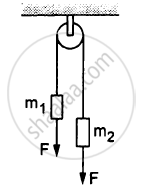
In the following figure, m1 = 5 kg, m2 = 2 kg and F = 1 N. Find the acceleration of either block. Describe the motion of m1 if the string breaks but F continues to act.
In the previous problem, suppose m2 = 2.0 kg and m3 = 3.0 kg. What should be the mass m, so that it remains at rest?
Use Newton's second law of motion to explain the following instance :
An athlete prefers to land on sand instead of hard floor while taking a high jump .
What do you understand by the term momentum?
Why is it advantageous to turn before taking a long jump?
Name the physical quantity which equals the rate of change of linear momentum.
Use Newton's second law to explain the following:
We always prefer to land on sand instead of hard floor while taking a high jump.
A cricket ball of mass 150 g has an initial velocity `u = (3hati + 4hatj)` m s−1 and a final velocity `v = - (3hati + 4hatj)` m s−1 after being hit. The change in momentum (final momentum-initial momentum) is (in kg m s1)
