Advertisements
Advertisements
Question
A stone is thrown vertically upward with a velocity of 9.8 m/s. When will it reach the ground?
Advertisements
Solution
Initial speed of ball is = 9.8 ms-1.
Acceleration due to gravity = -9.8 ms-2.
Final speed at maximum height = 0 ms-1.
We know v = u + at
0 = 9.8 - 9.8 t
T = 1 sec.
We know v2 - u2 =2as
At highest point final velocity is zero so
0 - 9.8 X 9.8 = 2 X (-9.8) S
S = 4.9 m.
for highest point initial velocity is zero
Acceleration due to gravity is = 9.8 ms-2.
Final velocity at ground is v
V2 - 0 = 2 X9.8 X 4.9
V = 9.8 ms-1.
Time taken to reach ground from highest point
V = u + at
9.8 = 0 + 9.8 t
T = 9.8/9.8 = 1 sec.
Total time = time of ascent + time of descent.
Total of flight = 1+ 1 = 2 seconds.
APPEARS IN
RELATED QUESTIONS
You are travelling in a car. The driver suddenly applies the brakes and you are pushed forward. Why does this happen?
When a horse pulls a cart, the force that helps the horse to move forward is the force exerted by
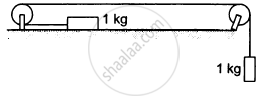
Calculate the tension in the string shown in the following figure. The pulley and the string are light and all the surfaces are frictionless. Take g = 10 m/s2.
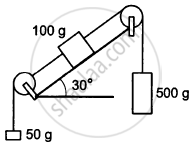
Find the acceleration of the 500 g block in the following figure.
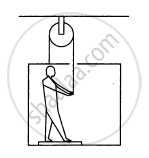
In the following figure shows a man of mass 60 kg standing on a light weighing machine kept in a box of mass 30 kg. The box is hanging from a pulley fixed to the ceiling by a light rope, the other end of which is held by the man himself. If the man manages to keep the box at rest, what is the weight recorded on the machine? What force should he exert on the rope to record his correct weight on the machine?
Use Newton's second law of motion to explain the following instance :
A cricketer pulls his hands back while catching a fast moving cricket ball .
State two factors which determine the momentum of a body.
Multiple Choice Question. Select the correct option.
A force acts on a body of mass 3 kg such that its velocity changes from 4 ms−1 to 10 ms−1. The change in momentum of the body is
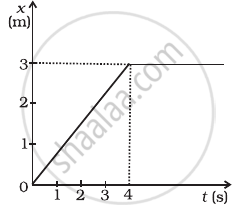
The position time graph of a body of mass 2 kg is as given in figure. What is the impulse on the body at t = 0 s and t = 4 s.
What happens when a car brakes to come to a stop?
