Advertisements
Advertisements
प्रश्न
A stone is thrown vertically upward with a velocity of 9.8 m/s. When will it reach the ground?
Advertisements
उत्तर
Initial speed of ball is = 9.8 ms-1.
Acceleration due to gravity = -9.8 ms-2.
Final speed at maximum height = 0 ms-1.
We know v = u + at
0 = 9.8 - 9.8 t
T = 1 sec.
We know v2 - u2 =2as
At highest point final velocity is zero so
0 - 9.8 X 9.8 = 2 X (-9.8) S
S = 4.9 m.
for highest point initial velocity is zero
Acceleration due to gravity is = 9.8 ms-2.
Final velocity at ground is v
V2 - 0 = 2 X9.8 X 4.9
V = 9.8 ms-1.
Time taken to reach ground from highest point
V = u + at
9.8 = 0 + 9.8 t
T = 9.8/9.8 = 1 sec.
Total time = time of ascent + time of descent.
Total of flight = 1+ 1 = 2 seconds.
APPEARS IN
संबंधित प्रश्न
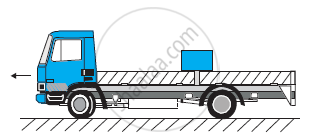
The rear side of a truck is open and a box of 40 kg mass is placed 5 m away from the open end as shown in Figure. The coefficient of friction between the box and the surface below it is 0.15. On a straight road, the truck starts from rest and accelerates with 2 m s–2. At what distance from the starting point does the box fall off the truck? (Ignore the size of the box).
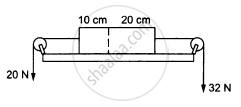
In the following figure shows a uniform rod of length 30 cm and mass 3.0 kg. The strings shown in the figure are pulled by constant forces of 20 N and 32 N. Find the force exerted by the 20 cm part of the rod on the 10 cm part. All the surfaces are smooth and the strings and the pulleys are light.
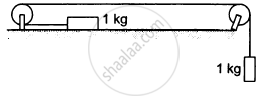
Calculate the tension in the string shown in the following figure. The pulley and the string are light and all the surfaces are frictionless. Take g = 10 m/s2.
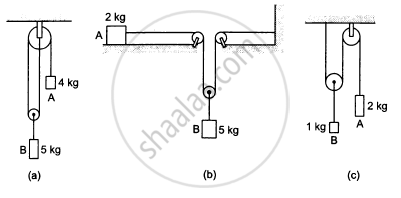
Find the acceleration of the blocks A and B in the three situations shown in the following figure.
Define linear momentum and state its S.I. unit.
The correct form of Newton's second law is :
What do you understand by the term momentum?
What do you mean by the conservation of momentum? Briefly, explain the collision between two bodies and the conservation of momentum.
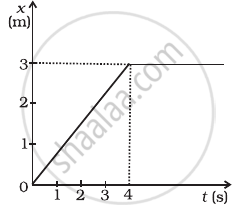
The position time graph of a body of mass 2 kg is as given in figure. What is the impulse on the body at t = 0 s and t = 4 s.
Why does a child feel more pain when she falls down on a hard cement floor, than when she falls on the soft muddy ground in the garden?
