Advertisements
Advertisements
प्रश्न
A stone is thrown vertically upward with a velocity of 9.8 m/s. When will it reach the ground?
Advertisements
उत्तर
Initial speed of ball is = 9.8 ms-1.
Acceleration due to gravity = -9.8 ms-2.
Final speed at maximum height = 0 ms-1.
We know v = u + at
0 = 9.8 - 9.8 t
T = 1 sec.
We know v2 - u2 =2as
At highest point final velocity is zero so
0 - 9.8 X 9.8 = 2 X (-9.8) S
S = 4.9 m.
for highest point initial velocity is zero
Acceleration due to gravity is = 9.8 ms-2.
Final velocity at ground is v
V2 - 0 = 2 X9.8 X 4.9
V = 9.8 ms-1.
Time taken to reach ground from highest point
V = u + at
9.8 = 0 + 9.8 t
T = 9.8/9.8 = 1 sec.
Total time = time of ascent + time of descent.
Total of flight = 1+ 1 = 2 seconds.
APPEARS IN
संबंधित प्रश्न
A helicopter of mass 1000 kg rises with a vertical acceleration of 15 m s–2. The crew and the passengers weigh 300 kg. Give the magnitude and direction of the
(a) force on the floor by the crew and passengers,
(b) action of the rotor of the helicopter on the surrounding air,
(c) force on the helicopter due to the surrounding air.
A smooth wedge A is fitted in a chamber hanging from a fixed ceiling near the earth's surface. A block B placed at the top of the wedge takes time T to slide down the length of the wedge. If the block is placed at the top of the wedge and the cable supporting the chamber is broken at the same instant, the block will.
A small block B is placed on another block A of mass 5 kg and length 20 cm. Initially, the block B is near the right end of block A (In the following Figure). A constant horizontal force of 10 N is applied to the block A. All the surfaces are assumed frictionless. Find the time that elapses before block B separates from A.
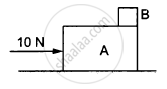
A block is kept on the floor of an elevator at rest. The elevator starts descending with an acceleration of 12 m/s2. Find the displacement of the block during the first 0.2 s after the start. Take g = 10 m/s2.
An aeroplane is moving uniformly at a constant height under the action of two forces (i) Upward force (lift) and (ii) Downward force (weight). What is the net force on the aeroplane?
A body of mass m moving with a velocity v is acted upon by a force. Write an expression for change in momentum in each of the following cases: (i) When v << c, (ii) When v → c and (iii) When v << c but m does not remain constant. Here, c is the speed of light.
Write the mathematical form of Newton's second law of motion. State the conditions if any.
A stone is dropped freely from the top of a tower and it reaches the ground in 4 s. Taking g = 10m s-2, calculate the height of the tower.
Which of the following has the largest inertia?
A hockey player is moving northward and suddenly turns westward with the same speed to avoid an opponent. The force that acts on the player is ______.
