Advertisements
Advertisements
प्रश्न
A ball is thrown vertically downward with an initial velocity of 10 m/s. What is its speed 1 s later and 2 s later?
Advertisements
उत्तर
Initial speed of ball = 10 ms-1.
Acceleration due to gravity on ball = - 9.8 ms-2
We know that from first equation of motion
v= u + gt.
After 1 sec
v= 10 - 9.8 X1
v= 0.2 ms-1
so velocity after 1 sec would be 0.2 ms-1.
Velocity after 2 seconds
v= 10 - 9.8X2 = 10 - 19.6 = -9.6 ms-1.
Here negative sign shows that velocity is in downward direction and magnitude is 9.6 ms-1.
APPEARS IN
संबंधित प्रश्न
A man of mass 70 kg stands on a weighing scale in a lift which is moving
- upwards with a uniform speed of 10 m s-1
- downwards with a uniform acceleration of 5 m s–2
- upwards with a uniform acceleration of 5 m s–2. What would be the readings on the scale in each case?
- What would be the reading if the lift mechanism failed and it hurtled down freely under gravity?
Explain why a cricketer moves his hands backwards while holding a catch.
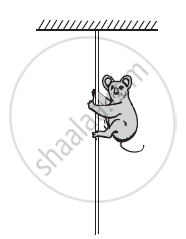
A monkey of mass 40 kg climbs on a rope in given Figure which can stand a maximum tension of 600 N. In which of the following cases will the rope break: the monkey
(a) climbs up with an acceleration of 6 m s–2
(b) climbs down with an acceleration of 4 m s–2
(c) climbs up with a uniform speed of 5 m s–1
(d) falls down the rope nearly freely under gravity?
(Ignore the mass of the rope).
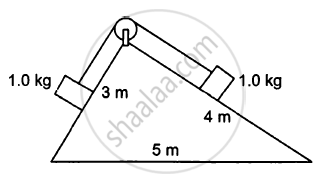
Consider the situation shown in the following figure All the surfaces are frictionless and the string and the pulley are light. Find the magnitude of acceleration of the two blocks.
Show that the rate of change of momentum = mass × acceleration. Under what condition does this relation hold?
The linear momentum of a ball of mass 50 g is 0.5 kg m s-1. Find its velocity.
A bullet of mass 50 g moving with an initial velocity 100 m s-1 strikes a wooden block and comes to rest after penetrating a distance 2 cm in it. Calculate: (i) Initial momentum of the bullet, (ii) Final momentum of the bullet, (iii) Retardation caused by the wooden block and (iv) Resistive force exerted by the wooden block.
Multiple Choice Question. Select the correct option.
The impulse of a body is equal to:
A cricket ball of mass 150 g has an initial velocity `u = (3hati + 4hatj)` m s−1 and a final velocity `v = - (3hati + 4hatj)` m s−1 after being hit. The change in momentum (final momentum-initial momentum) is (in kg m s1)
A woman throws an object of mass 500 g with a speed of 25 ms1.
- What is the impulse imparted to the object?
- If the object hits a wall and rebounds with half the original speed, what is the change in momentum of the object?
