Advertisements
Advertisements
प्रश्न
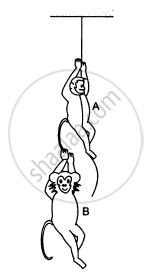
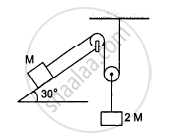
Find the acceleration of the 500 g block in the following figure.
Advertisements
उत्तर
Given,
m1 = 100 g = 0.1 kg
m2 = 500 g = 0.5 kg
m3 = 50 g = 0.05 kg
The free-body diagram for the system is shown below: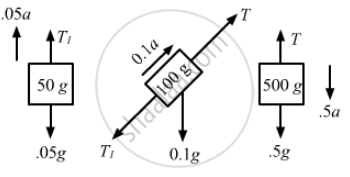
From the free-body diagram of the 500 g block,
T + 0.5a − 0.5g = 0 .....(i)
From the free-body diagram of the 50 g block,
T1 + 0.05g − 0.05a = a ....(ii)
From the free-body diagram of the 100 g block,
T1 + 0.1a − T + 0.5g = 0 ....(iii)
From equation (ii),
T1 = 0.05g + 0.05a .....(iv)
From equation (i),
T1 = 0.5g − 0.5a .....(v)
Equation (iii) becomes
T1 + 0.1a − T + 0.05g = 0
From equations (iv) and (v), we get:
0.05g + 0.05a + 0.1a − 0.5g + 0.5a + 0.05g = 0
0.65a = 0.4 g
\[\Rightarrow a = \frac{0 . 4}{0 . 65}g\]
\[ = \frac{40}{65}g = \frac{8}{13}g \left(\text{ downward }\right)\]
So, the acceleration of the 500 gm block is
\[\frac{8g}{13}\] downward.
APPEARS IN
संबंधित प्रश्न
An aircraft executes a horizontal loop at a speed of 720 km/h with its wings banked at 15°. What is the radius of the loop?
A free 238U nucleus kept in a train emits an alpha particle. When the train is stationary, a nucleus decays and a passenger measures that the separation between the alpha particle and the recoiling nucleus becomes x at time t after the decay. If the decay takes place while the train is moving at a uniform velocity v, the distance between the alpha particle and the recoiling nucleus at a time t after the decay, as measured by the passenger, is
car moving at 40 km/hr is to be stopped by applying brakes in the next 4 m. If the car weighs 2000 kg, what average force must be applied to stop it?
Two blocks A and B of mass mA and mB , respectively, are kept in contact on a frictionless table. The experimenter pushes block A from behind, so that the blocks accelerate. If block A exerts force F on block B, what is the force exerted by the experimenter on block A?
A man has fallen into a ditch of width d and two of his friends are slowly pulling him out using a light rope and two fixed pulleys as shown in the following figure. Show that the force (assumed equal for both the friends) exerted by each friend on the road increases as the man moves up. Find the force when the man is at a depth h.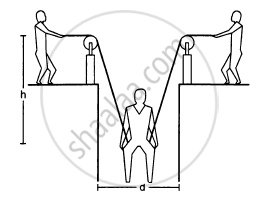
Consider the Atwood machine of the previous problem. The larger mass is stopped for a moment, 2.0 s after the system is set into motion. Find the time that elapses before the string is tight again.
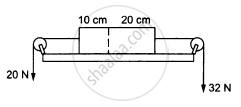
In the following figure shows a uniform rod of length 30 cm and mass 3.0 kg. The strings shown in the figure are pulled by constant forces of 20 N and 32 N. Find the force exerted by the 20 cm part of the rod on the 10 cm part. All the surfaces are smooth and the strings and the pulleys are light.
Find the acceleration of the block of mass M in the situation shown in the following figure. All the surfaces are frictionless and the pulleys and the string are light.
A block is kept on the floor of an elevator at rest. The elevator starts descending with an acceleration of 12 m/s2. Find the displacement of the block during the first 0.2 s after the start. Take g = 10 m/s2.
The linear momentum of a body of mass m moving with velocity v is :
Calculate the magnitude of force which when applied on a body of mass 0.5 kg produces an acceleration of 5 m s-2.
Calculate the velocity of a body of mass 0.5 kg, when it has a linear momentum of 5 Ns.
ame the law of motion which gives the definition of force.
A stone is dropped from a cliff 98 m high.
What will be its speed when it strikes the ground?
A stone is thrown vertically upward with a velocity of 9.8 m/s. When will it reach the ground?
A ball is thrown upward and reaches a maximum height of 19.6 m. Find its initial speed?
A stone is dropped from a tower 98 m high. With what speed should a second stone be thrown 1 s later so that both hit the ground at the same time?
A hockey player is moving northward and suddenly turns westward with the same speed to avoid an opponent. The force that acts on the player is ______.
The motion of a particle of mass m is given by x = 0 for t < 0 s, x(t) = A sin 4 pt for 0 < t < (1/4) s (A > o), and x = 0 for t > (1/4) s. Which of the following statements is true?
- The force at t = (1/8) s on the particle is – 16π2 Am.
- The particle is acted upon by on impulse of magnitude 4π2 A m at t = 0 s and t = (1/4) s.
- The particle is not acted upon by any force.
- The particle is not acted upon by a constant force.
- There is no impulse acting on the particle.
