Advertisements
Advertisements
प्रश्न
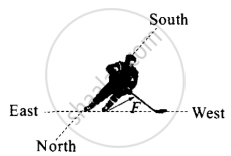
A hockey player is moving northward and suddenly turns westward with the same speed to avoid an opponent. The force that acts on the player is ______.
विकल्प
frictional force along westward.
muscle force along southward.
frictional force along south-west.
muscle force along south-west.
Advertisements
उत्तर
A hockey player is moving northward and suddenly turns westward with the same speed to avoid an opponent. The force that acts on the player is frictional force along south-west.
Explanation:
According to Newton’s second law of motion, only external forces can change the linear momentum of the system. The internal forces cannot change the linear momentum of system under consideration. If we take hockey players as a system, the external force which can change the direction of motion of the player is the force that must be friction between the ground and the shoes of player. The muscle force is the internal force, this cannot change the linear momentum of the player.
According to Newton’s Second Law, The rate of change of linear momentum of a body is equal to the external force applied on the body or F = dp/dt. So, the external force must be in the direction of change in momentum.
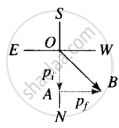
As shown in the diagram,
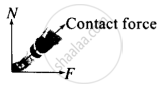
Let OA = p1
= Initial momentum of player northward
AB = p2
= Final momentum of the player towards west
Clearly OB = OA + AB
According to the problem, mass = 2 kg
The position of the particle is given here as a function of time, x(t) = pt + qt2 + rt3 By differentiating this equation w.r.t. time we get velocity of the particle as a function of time.
v = dx/dt = p + 2 qt + 3 rt2
If we again differentiate this equation w.r.t. time, we will get an acceleration of the particle as a function of time.
a = dv/dt = 0 + 2q + 6rt
At t = 2 s; a = 2q + 6 × 2 × r
= 2 q + 12 r
= 2 × 4 + 12 × 5
= 8 + 60
= 68 m/s
Force = F = ma
= 2 × 68
= 136 N
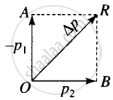
Change in momentum = p2 – p1
= AB – OA
= AB + (– OA)
= Clearly the change in momentum is OR will be along southwest, so the direction of force will also be along southwest.
APPEARS IN
संबंधित प्रश्न
A man of mass 70 kg stands on a weighing scale in a lift which is moving
- upwards with a uniform speed of 10 m s-1
- downwards with a uniform acceleration of 5 m s–2
- upwards with a uniform acceleration of 5 m s–2. What would be the readings on the scale in each case?
- What would be the reading if the lift mechanism failed and it hurtled down freely under gravity?
A stone of mass m tied to the end of a string revolves in a vertical circle of radius R. The net forces at the lowest and highest points of the circle directed vertically downwards are: [Choose the correct alternative]
| Lowest Point | Highest Point | |
| a) | mg – T1 | mg + T2 |
| b) | mg + T1 | mg – T2 |
| c) | `mg + T1 –(m_v_1^2)/R` | mg – T2 + (`mv_1^2`)/R |
| d) | `mg – T1 – (mv)/R` | mg + T2 + (mv_1^2)/R |
T1 and v1 denote the tension and speed at the lowest point. T2 and v2 denote corresponding values at the highest point.
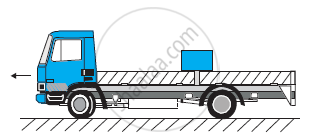
The rear side of a truck is open and a box of 40 kg mass is placed 5 m away from the open end as shown in Figure. The coefficient of friction between the box and the surface below it is 0.15. On a straight road, the truck starts from rest and accelerates with 2 m s–2. At what distance from the starting point does the box fall off the truck? (Ignore the size of the box).
When a horse pulls a cart, the force that helps the horse to move forward is the force exerted by
A car accelerates on a horizontal road due to the force exerted by.
If the tension in the cable supporting an elevator is equal to the weight of the elevator, the elevator may be
(a) going up with increasing speed
(b) going down with increasing speed
(c) going up with uniform speed
(d) going down with uniform speed
In a TV picture tube, electrons are ejected from the cathode with negligible speed and they attain a velocity of 5 × 10⁶ m/s in travelling one centimetre. Assuming straight-line motion, find the constant force exerted on the electrons. The mass of an electron is 9.1 × 10⁻³¹ kg.
A particle of mass 0.3 kg is subjected to a force F = −kx with k = 15 N/m. What will be its initial acceleration if it is released from a point x = 20 cm?
Suppose the ceiling in the previous problem is that of an elevator which is going up with an acceleration of 2.0 m/s2. Find the elongation.
In a simple Atwood machine, two unequal masses m1 and m2 are connected by a string going over a clamped light smooth pulley. In a typical arrangement (In the following figure), m1 = 300 g and m2 = 600 g. The system is released from rest. (a) Find the distance travelled by the first block in the first two seconds; (b) find the tension in the string; (c) find the force exerted by the clamp on the pulley.
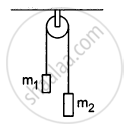
Consider the Atwood machine of the previous problem. The larger mass is stopped for a moment, 2.0 s after the system is set into motion. Find the time that elapses before the string is tight again.
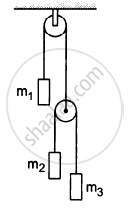
Let m1 = 1 kg, m2 = 2 kg and m3 = 3 kg in the following figure. Find the accelerations of m1, m2 and m3. The string from the upper pulley to m1 is 20 cm when the system is released from rest. How long will it take before m1 strikes the pulley?
A body of mass m moving with a velocity v is acted upon by a force. Write an expression for change in momentum in each of the following cases: (i) When v << c, (ii) When v → c and (iii) When v << c but m does not remain constant. Here, c is the speed of light.
Two bodies A and B of same mass are moving with velocities v and 2v, respectively. Compare their (i) inertia and (ii) momentum.
Calculate the velocity of a body of mass 0.5 kg, when it has a linear momentum of 5 Ns.
Multiple Choice Question. Select the correct option.
The impulse of a body is equal to:
ame the law of motion which gives the definition of force.
What causes motion in a body?
What do you mean by linear momentum of a body?
How does moving your hand backward while catching a cricket ball reduce pain?
