Advertisements
Advertisements
प्रश्न
What do you mean by linear momentum of a body? A force causes an acceleration of 10 ms-2 in a body of mass 1 kg. What acceleration will be caused by the same force in a body of mass 4 kg?
Advertisements
उत्तर
Linear Momentum is defined as the physical quantity which is associated with bodies in linear motion. It is given by the product of the mass of the body and its velocity.
Mass of body = 1 kg
Acceleration produced = 10 ms-2.
Force applied would be = 1 X 10 N = 10 N.
Mass of second body = 4 kg.
As same force has to be applied on second body so force = 10N.
Acceleration produced is = F/M =10/4 = 2.5 ms-2.
APPEARS IN
संबंधित प्रश्न
An object is placed far away from all the objects that can exert force on it. A frame of reference is constructed by taking the origin and axes fixed in this object. Will the frame be necessarily inertial?
A car accelerates on a horizontal road due to the force exerted by.
A person says that he measured the acceleration of a particle to be non-zero even though no force was acting on the particle.
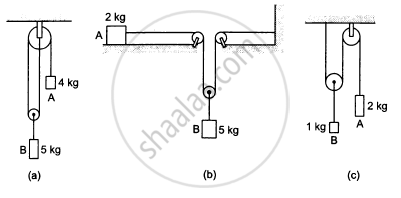
Find the acceleration of the blocks A and B in the three situations shown in the following figure.
The unit of linear momentum is :
A force acts for 10 s on a stationary body of mass 100 kg, after which the force ceases to act. The body moves through a distance of 100 m in the next 5 s. Calculate : The magnitude of the force
State two factors which determine the momentum of a body.
Why is it advantageous to turn before taking a long jump?
A ball is thrown vertically downward with an initial velocity of 10 m/s. What is its speed 1 s later and 2 s later?
In the previous problem (5.3), the magnitude of the momentum transferred during the hit is ______.
