Advertisements
Advertisements
प्रश्न
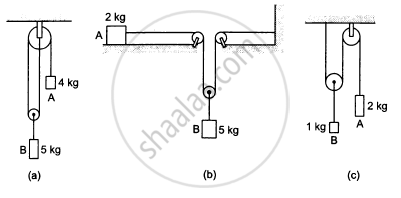
Find the acceleration of the blocks A and B in the three situations shown in the following figure.
Advertisements
उत्तर
(a) 5a + T − 5g = 0
From free-body diagram (1),
T = 5g − 5a .....(i)
Again,
\[\left( \frac{1}{2} \right)T - 4g - 8a = 0\]
⇒ T − 8g − 16a = 0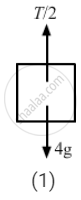
From free-body diagram (2),
T = 8g + 16a ......(ii)
From equations (i) and (ii), we get:
5g − 5a = 8g + 16a
\[\Rightarrow 21a = - 3g - a = - \frac{9}{7}\]
So, the acceleration of the 5 kg mass is \[\frac{9}{7} m/ s^2 \left(\text{ upward }\right)\] and that of the 4 kg mass is
\[2a = \frac{2g}{7} \left(\text{ downward }\right)\]
\[4a - \frac{T}{2} = 0\]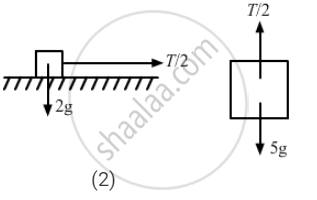
⇒ 8a − T = 0
⇒ T = 8a
Again, T + 5a − 5g = 0
From free body diagram-4,
8a + 5a − 5g = s0
⇒ 13a − 5g = 0
\[\Rightarrow a = \frac{5g}{13} \left(\text{ downward }\right)\]
Acceleration of mass 2 kg is \[2a = \frac{10}{13} \left( g \right)\] and 5 kg is
\[\frac{5g}{13}\].
(c) T + 1a − 1g = 0
From free body diagram-5
T = 1g − 1a .....(i)
Again, from free body diagram-6,
\[\frac{T}{2} - 2g - 4a = 0\]
⇒ T − 4g − 8a = 0 .....(ii)
From equation (i)
1g − 1a − 4g − 8a = 0
\[\Rightarrow a = \frac{g}{3}\left(\text{ downward }\right)\]
Acceleration of mass 1 kg is \[\frac{g}{3} \left(\text{ upward }\right)\]
Acceleration of mass 2 kg is \[\frac{2g}{3} \left(\text{ downward }\right)\] 
APPEARS IN
संबंधित प्रश्न
A person says that he measured the acceleration of a particle to be non-zero even though no force was acting on the particle.
Two blocks of equal mass m are tied to each other through a light string. One of the blocks is pulled along the line joining them with a constant force F. Find the tension in the string joining the blocks.
A man has fallen into a ditch of width d and two of his friends are slowly pulling him out using a light rope and two fixed pulleys as shown in the following figure. Show that the force (assumed equal for both the friends) exerted by each friend on the road increases as the man moves up. Find the force when the man is at a depth h.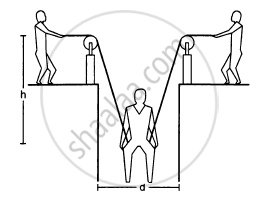
Suppose the ceiling in the previous problem is that of an elevator which is going up with an acceleration of 2.0 m/s2. Find the elongation.
A tennis ball and a cricket ball , both are stationary. To start motion in them .
State the Newton's second law of motion. What information do you get from it?
Write the mathematical form of Newton's second law of motion. State the conditions if any.
State Newton's second law of motion. Under what condition does it take the form F = ma?
The correct form of Newton's second law is :
The linear momentum of a body of mass m moving with velocity v is :
Calculate the magnitude of force which when applied on a body of mass 0.5 kg produces an acceleration of 5 m s-2.
A bullet of mass 50 g moving with an initial velocity 100 m s-1 strikes a wooden block and comes to rest after penetrating a distance 2 cm in it. Calculate: (i) Initial momentum of the bullet, (ii) Final momentum of the bullet, (iii) Retardation caused by the wooden block and (iv) Resistive force exerted by the wooden block.
A stone is dropped freely from the top of a tower and it reaches the ground in 4 s. Taking g = 10m s-2, calculate the height of the tower.
Calculate the velocity of a body of mass 0.5 kg, when it has a linear momentum of 5 Ns.
What do you mean by an impulsive force?
State Newton's second law of motion.
A body of mass 400 g is resting on a frictionless table. Find the acceleration of the body when acted upon by a force of 0.02 N.
Use Newton's second law to explain the following:
While catching a fast moving ball, we always pull our hands backwards.
A ball is thrown vertically downward with an initial velocity of 10 m/s. What is its speed 1 s later and 2 s later?
A cricket ball of mass 150 g has an initial velocity `u = (3hati + 4hatj)` m s−1 and a final velocity `v = - (3hati + 4hatj)` m s−1 after being hit. The change in momentum (final momentum-initial momentum) is (in kg m s1)
A woman throws an object of mass 500 g with a speed of 25 ms1.
- What is the impulse imparted to the object?
- If the object hits a wall and rebounds with half the original speed, what is the change in momentum of the object?
