Advertisements
Advertisements
प्रश्न
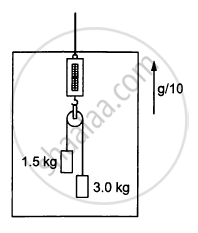
Find the reading of the spring balance shown in the following figure. The elevator is going up with an acceleration g/10, the pulley and the string are light and the pulley is smooth.
Advertisements
उत्तर
Let the left and right blocks be A and B, respectively.
And let the acceleration of the 3 kg mass relative to the elevator be 'a' in the downward direction.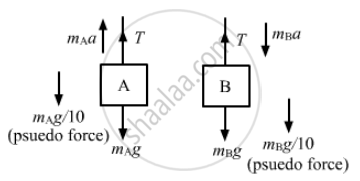
From the free-body diagram,
\[m_A a = T - m_A g - \frac{m_A g}{10} . . . \left( 1 \right)\]
\[m_B a = m_B g + \frac{m_B g}{10} - T . . . \left( 2 \right)\]
Adding both the equations, we get:
\[a\left( m_A + m_B \right) = \left( m_B - m_A \right)g + \left( m_B - m_A \right)\frac{g}{10}\]
Putting value of the masses,we get:
\[9a = \frac{33g}{10}\]
\[ \Rightarrow \frac{a}{g} = \frac{11}{30} . . . \left( 3 \right)\]
Now, using equation (1), we get:
\[T = m_A \left( a + g + \frac{g}{10} \right)\]
The reading of the spring balance =\[\frac{2T}{g} = \frac{2}{g} m_A \left( a + g + \frac{g}{10} \right)\]
\[\Rightarrow 2 \times 1 . 5\left( \frac{a}{g} + 1 + \frac{1}{10} \right) = 3\left( \frac{11}{30} + 1 + \frac{1}{10} \right)\]
= 4 . 4 kg
APPEARS IN
संबंधित प्रश्न
A stone of mass m tied to the end of a string revolves in a vertical circle of radius R. The net forces at the lowest and highest points of the circle directed vertically downwards are: [Choose the correct alternative]
| Lowest Point | Highest Point | |
| a) | mg – T1 | mg + T2 |
| b) | mg + T1 | mg – T2 |
| c) | `mg + T1 –(m_v_1^2)/R` | mg – T2 + (`mv_1^2`)/R |
| d) | `mg – T1 – (mv)/R` | mg + T2 + (mv_1^2)/R |
T1 and v1 denote the tension and speed at the lowest point. T2 and v2 denote corresponding values at the highest point.
When a horse pulls a cart, the force that helps the horse to move forward is the force exerted by
A smooth wedge A is fitted in a chamber hanging from a fixed ceiling near the earth's surface. A block B placed at the top of the wedge takes time T to slide down the length of the wedge. If the block is placed at the top of the wedge and the cable supporting the chamber is broken at the same instant, the block will.
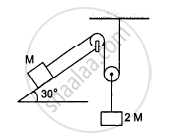
Find the acceleration of the block of mass M in the situation shown in the following figure. All the surfaces are frictionless and the pulleys and the string are light.
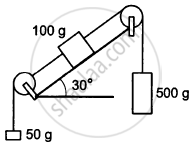
Find the acceleration of the 500 g block in the following figure.
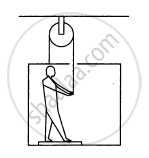
In the following figure shows a man of mass 60 kg standing on a light weighing machine kept in a box of mass 30 kg. The box is hanging from a pulley fixed to the ceiling by a light rope, the other end of which is held by the man himself. If the man manages to keep the box at rest, what is the weight recorded on the machine? What force should he exert on the rope to record his correct weight on the machine?
Show that the rate of change of momentum = mass × acceleration. Under what condition does this relation hold?
The unit of linear momentum is :
The linear momentum of a ball of mass 50 g is 0.5 kg m s-1. Find its velocity.
A stone is dropped freely from the top of a tower and it reaches the ground in 4 s. Taking g = 10m s-2, calculate the height of the tower.
An electron of mass 9 × 10⁻³¹ kg is moving with a linear velocity of 6 × 10⁷ ms−1. Calculate the linear momentum of electron.
Multiple Choice Question. Select the correct option.
A force acts on a body of mass 3 kg such that its velocity changes from 4 ms−1 to 10 ms−1. The change in momentum of the body is
ame the law of motion which gives the definition of force.
State Newton's second law of motion. Is Newton's first law of motion contained in Newton's second law of motion?
What do you mean by an impulsive force?
State Newton's second law of motion.
A body of mass 400 g is resting on a frictionless table. Find the acceleration of the body when acted upon by a force of 0.02 N.
A stone is dropped from a cliff 98 m high.
What will be its speed when it strikes the ground?
According to Newton's Second Law of Motion, what quantity is directly proportional to the applied force?
As shown in figure, a 70 kg garden roller is pushed with a force of F = 200 N at an angle of 30° with horizontal. The normal reaction on the roller is: (Given: g = 10 ms−2)