Advertisements
Advertisements
प्रश्न
A person drops a coin. Describe the path of the coin as seen by the person if he is in
- a car moving at constant velocity and
- in a free falling elevator.
Advertisements
उत्तर
When the person drops the coin, the path of the coin as seen by the person is:
(a)
- When a person drops a coin inside a car moving at constant velocity, the coin appears to fall straight down from the person’s point of view.
- This is because both the person and the coin are moving forward with the same velocity as the car.
- There is no additional force acting on the coin in the horizontal direction, so the coin retains its forward motion and lands directly below the point from which it was dropped.
- This situation reflects the principle of relative motion and supports Newton’s first law an object in motion continues in motion unless acted upon by an external force.
(b)
- In a free falling elevator, both the person and the coin are accelerating downward at the same rate due to gravity.
- When the person drops the coin, from their point of view, it appears to hover, float in the air, or fall very slowly.
- The person and the coin are both in free fall together, so there is no relative acceleration.
- This provides the sensation of weightlessness, similar to what astronauts experience in orbit.
APPEARS IN
संबंधित प्रश्न
A body of mass 0.40 kg moving initially with a constant speed of 10 m s–1 to the north is subject to a constant force of 8.0 N directed towards the south for 30 s. Take the instant the force is applied to be t = 0, the position of the body at that time to be x = 0, and predict its position at t = –5 s, 25 s, 100 s.
A man of mass 70 kg stands on a weighing scale in a lift which is moving
- upwards with a uniform speed of 10 m s-1
- downwards with a uniform acceleration of 5 m s–2
- upwards with a uniform acceleration of 5 m s–2. What would be the readings on the scale in each case?
- What would be the reading if the lift mechanism failed and it hurtled down freely under gravity?
A batsman deflects a ball by an angle of 45° without changing its initial speed which is equal to 54 km/h. What is the impulse imparted to the ball? (Mass of the ball is 0.15 kg.)
Explain why a cricketer moves his hands backwards while holding a catch.
When a horse pulls a cart, the force that helps the horse to move forward is the force exerted by
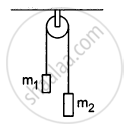
In a simple Atwood machine, two unequal masses m1 and m2 are connected by a string going over a clamped light smooth pulley. In a typical arrangement (In the following figure), m1 = 300 g and m2 = 600 g. The system is released from rest. (a) Find the distance travelled by the first block in the first two seconds; (b) find the tension in the string; (c) find the force exerted by the clamp on the pulley.
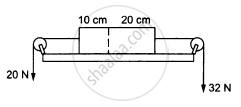
In the following figure shows a uniform rod of length 30 cm and mass 3.0 kg. The strings shown in the figure are pulled by constant forces of 20 N and 32 N. Find the force exerted by the 20 cm part of the rod on the 10 cm part. All the surfaces are smooth and the strings and the pulleys are light.
A body of mass m moving with a velocity v is acted upon by a force. Write an expression for change in momentum in each of the following cases: (i) When v << c, (ii) When v → c and (iii) When v << c but m does not remain constant. Here, c is the speed of light.
State Newton's second law of motion. Under what condition does it take the form F = ma?
How can Newton's first law of motion be obtained from the second law of motion?
Use Newton's second law of motion to explain the following instance :
An athlete prefers to land on sand instead of hard floor while taking a high jump .
The correct form of Newton's second law is :
A body of mass 200 g is moving with a velocity of 5 ms−1. If the velocity of the body changes to 17 ms−1, calculate the change in linear momentum of the body.
What do you understand by the term momentum?
Which of the following has the largest inertia?
Use Newton's second law to explain the following:
While catching a fast moving ball, we always pull our hands backwards.
A ball is thrown upward and reaches a maximum height of 19.6 m. Find its initial speed?
A stone is dropped from a tower 98 m high. With what speed should a second stone be thrown 1 s later so that both hit the ground at the same time?
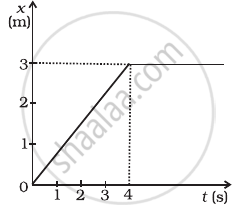
The position time graph of a body of mass 2 kg is as given in figure. What is the impulse on the body at t = 0 s and t = 4 s.
How does moving your hand backward while catching a cricket ball reduce pain?
