Advertisements
Advertisements
प्रश्न
A cricket ball of mass 150 g has an initial velocity `u = (3hati + 4hatj)` m s−1 and a final velocity `v = - (3hati + 4hatj)` m s−1 after being hit. The change in momentum (final momentum-initial momentum) is (in kg m s1)
विकल्प
zero
`-(0.45 hati + 0.6 hatj)`
`-(0.9 hati + 1.2 hatj)`
`-5 (hati + hatj)`
Advertisements
उत्तर
`-(0.9 hati + 1.2 hatj)`
Explanation:
Given, `u = (3hati + 4hatj)` m/s
And `v = - (3hati + 4hatj)` m/s
Mass of the ball = 150 g = 0.15 kg
Δp = Change in momentum
= Final momentum – Initial momentum
= `mv - mu`
= `m(v - u) = (0.15) [- (3hati + 4hatj) - (3hati + 4hatj)]`
= `(0.15) xx [ - 6hati - 8hatj]`
= `- [0.15 xx 6hati + 0.15 xx 8hatj]`
= `- [0.9 hati + 1.20 hatj]`
Hence, Δp = `-[0.9 hati + 1.2 hatj]`
APPEARS IN
संबंधित प्रश्न
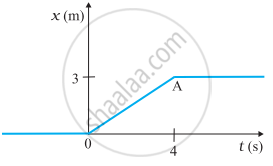
The below figure shows the position-time graph of a particle of mass 4 kg.
- What is the force on the particle for t < 0, t > 4 s, 0 < t < 4 s?
- What is the impulse at t = 0 and t = 4 s? (Consider one-dimensional motion only.)
An aircraft executes a horizontal loop at a speed of 720 km/h with its wings banked at 15°. What is the radius of the loop?
The force of buoyancy exerted by the atmosphere on a balloon is B in the upward direction and remains constant. The force of air resistance on the balloon acts opposite the direction of velocity and is proportional to it. The balloon carries a mass M and is found to fall to the earth's surface with a constant velocity v. How much mass should be removed from the balloon so that it may rise with a constant velocity v?
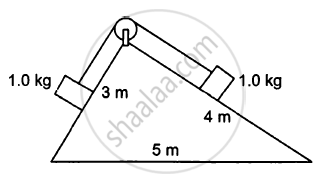
Consider the situation shown in the following figure All the surfaces are frictionless and the string and the pulley are light. Find the magnitude of acceleration of the two blocks.
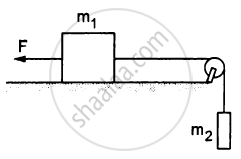
A constant force F = m2g/2 is applied on the block of mass m1 as shown in the following figure. The string and the pulley are light and the surface of the table is smooth. Find the acceleration of m1.
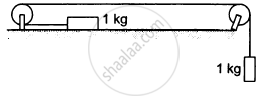
Calculate the tension in the string shown in the following figure. The pulley and the string are light and all the surfaces are frictionless. Take g = 10 m/s2.
Consider the situation shown in the following figure. Both the pulleys and the string are light and all the surfaces are frictionless.
- Find the acceleration of the mass M.
- Find the tension in the string.
- Calculate the force exerted by the clamp on the pulley A in the figure.
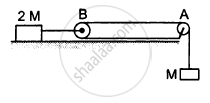
Find the acceleration of the block of mass M in the situation shown in the following figure. All the surfaces are frictionless and the pulleys and the string are light.
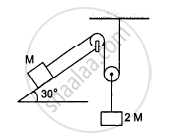
The unit of linear momentum is :
A force acts for 10 s on a stationary body of mass 100 kg, after which the force ceases to act. The body moves through a distance of 100 m in the next 5 s. Calculate : The magnitude of the force
A bullet of mass 50 g moving with an initial velocity 100 m s-1 strikes a wooden block and comes to rest after penetrating a distance 2 cm in it. Calculate: (i) Initial momentum of the bullet, (ii) Final momentum of the bullet, (iii) Retardation caused by the wooden block and (iv) Resistive force exerted by the wooden block.
An electron of mass 9 × 10⁻³¹ kg is moving with a linear velocity of 6 × 10⁷ ms−1. Calculate the linear momentum of electron.
What do you mean by linear momentum of a body?
Why is it advantageous to turn before taking a long jump?
State Newton's second law of motion.
A body of mass 400 g is resting on a frictionless table. Find the acceleration of the body when acted upon by a force of 0.02 N.
Use Newton's second law to explain the following:
While catching a fast moving ball, we always pull our hands backwards.
A woman throws an object of mass 500 g with a speed of 25 ms1.
- What is the impulse imparted to the object?
- If the object hits a wall and rebounds with half the original speed, what is the change in momentum of the object?
According to Newton's Second Law of Motion, what quantity is directly proportional to the applied force?
Why is catching a slow-moving ball easier than catching a fast-moving ball?
