Advertisements
Advertisements
प्रश्न
A cricket ball of mass 150 g has an initial velocity `u = (3hati + 4hatj)` m s−1 and a final velocity `v = - (3hati + 4hatj)` m s−1 after being hit. The change in momentum (final momentum-initial momentum) is (in kg m s1)
पर्याय
zero
`-(0.45 hati + 0.6 hatj)`
`-(0.9 hati + 1.2 hatj)`
`-5 (hati + hatj)`
Advertisements
उत्तर
`-(0.9 hati + 1.2 hatj)`
Explanation:
Given, `u = (3hati + 4hatj)` m/s
And `v = - (3hati + 4hatj)` m/s
Mass of the ball = 150 g = 0.15 kg
Δp = Change in momentum
= Final momentum – Initial momentum
= `mv - mu`
= `m(v - u) = (0.15) [- (3hati + 4hatj) - (3hati + 4hatj)]`
= `(0.15) xx [ - 6hati - 8hatj]`
= `- [0.15 xx 6hati + 0.15 xx 8hatj]`
= `- [0.9 hati + 1.20 hatj]`
Hence, Δp = `-[0.9 hati + 1.2 hatj]`
APPEARS IN
संबंधित प्रश्न
A rocket with a lift-off mass 20,000 kg is blasted upwards with an initial acceleration of 5.0 m s–2. Calculate the initial thrust (force) of the blast.
A block of mass 15 kg is placed on a long trolley. The coefficient of static friction between the block and the trolley is 0.18. The trolley accelerates from rest with 0.5 ms–2 for 20 s and then moves with uniform velocity. Discuss the motion of the block as viewed by (a) a stationary observer on the ground, (b) an observer moving with the trolley.
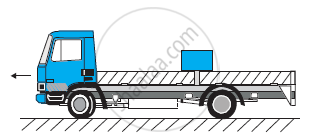
The rear side of a truck is open and a box of 40 kg mass is placed 5 m away from the open end as shown in Figure. The coefficient of friction between the box and the surface below it is 0.15. On a straight road, the truck starts from rest and accelerates with 2 m s–2. At what distance from the starting point does the box fall off the truck? (Ignore the size of the box).
An object is placed far away from all the objects that can exert force on it. A frame of reference is constructed by taking the origin and axes fixed in this object. Will the frame be necessarily inertial?
If the tension in the cable supporting an elevator is equal to the weight of the elevator, the elevator may be
(a) going up with increasing speed
(b) going down with increasing speed
(c) going up with uniform speed
(d) going down with uniform speed
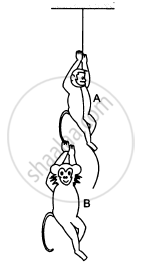
The monkey B, shown in the following figure, is holding on to the tail of monkey A that is climbing up a rope. The masses of monkeys A and B are 5 kg and 2 kg, respectively. If A can tolerate a tension of 30 N in its tail, what force should it apply on the rope in order to carry monkey B with it? Take g = 10 m/s2.
Show that the rate of change of momentum = mass × acceleration. Under what condition does this relation hold?
Write the mathematical form of Newton's second law of motion. State the conditions if any.
Use Newton's second law of motion to explain the following instance :
An athlete prefers to land on sand instead of hard floor while taking a high jump .
The correct form of Newton's second law is :
The linear momentum of a body of mass m moving with velocity v is :
A pebble is dropped freely in a well from its top. It takes 20 s for the pebble to reach the water surface in the well. Taking g = 10 m s-2 and speed of sound = 330 m s-1. Find : The depth of water surface
What do you understand by the term momentum?
Why is it advantageous to turn before taking a long jump?
What do you mean by linear momentum of a body? A force causes an acceleration of 10 ms-2 in a body of mass 1 kg. What acceleration will be caused by the same force in a body of mass 4 kg?
A stone is dropped from a cliff 98 m high.
How long will it take to fall to the foot of the cliff?
A stone is dropped from a cliff 98 m high.
What will be its speed when it strikes the ground?
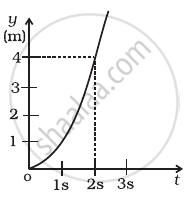
Figure shows (x, t), (y, t ) diagram of a particle moving in 2-dimensions.
|
|
 (b) |
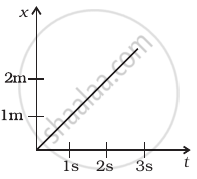
If the particle has a mass of 500 g, find the force (direction and magnitude) acting on the particle.
