Advertisements
Advertisements
प्रश्न
Show that the rate of change of momentum = mass × acceleration. Under what condition does this relation hold?
Advertisements
उत्तर १
Let a force 'F' be applied on a body of mass m for a time 't' due to which its velocity changes from u to v. Then,
Initial momentum of body = mu
Final momentum of body = mv
Change in momentum of the body in 't' seconds = mv - mu = m (v - u)
Rate of change of momentum = Change in momentum/time
= [m (v - u)]/t
However, acceleration a = Change in velocity/time = (v - u)/t
Therefore, rate of change of momentum = ma = mass × acceleration
This relation holds true when the mass of the body remains constant.
उत्तर २
According to newton second law
F = m X a
a= (v - u)/t.
F = m(v -u)/t
F = (mv - mu)/t
As F= m X a
ma = (mv - mu)/t
so rate of change of momentum = mass X acceleration.
This relation holds good when mass remains constant during motion.
संबंधित प्रश्न
Explain why a cricketer moves his hands backwards while holding a catch.
You are travelling in a car. The driver suddenly applies the brakes and you are pushed forward. Why does this happen?
A spy jumps from an airplane with his parachute. The spy accelerates downward for some time when the parachute opens. The acceleration is suddenly checked and the spy slowly falls to the ground. Explain the action of the parachute in checking the acceleration.
A person says that he measured the acceleration of a particle to be non-zero even though no force was acting on the particle.
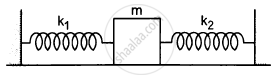
Both the springs shown in the following figure are unstretched. If the block is displaced by a distance x and released, what will be the initial acceleration?
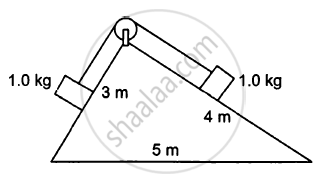
Consider the situation shown in the following figure All the surfaces are frictionless and the string and the pulley are light. Find the magnitude of acceleration of the two blocks.
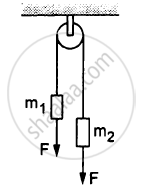
In the following figure, m1 = 5 kg, m2 = 2 kg and F = 1 N. Find the acceleration of either block. Describe the motion of m1 if the string breaks but F continues to act.
A body of mass m moving with a velocity v is acted upon by a force. Write an expression for change in momentum in each of the following cases: (i) When v << c, (ii) When v → c and (iii) When v << c but m does not remain constant. Here, c is the speed of light.
The unit of linear momentum is :
What do you mean by linear momentum of a body? A force causes an acceleration of 10 ms-2 in a body of mass 1 kg. What acceleration will be caused by the same force in a body of mass 4 kg?
