Advertisements
Advertisements
प्रश्न
The linear momentum of a ball of mass 50 g is 0.5 kg m s-1. Find its velocity.
Advertisements
उत्तर
Linear momentum = 0.5 kg m/s
Mass, m = 50 g = 0.05 kg
Velocity = Linear momentum/mass
= 0.5/0.05 m/s
= 10 m/s -1
APPEARS IN
संबंधित प्रश्न
A batsman deflects a ball by an angle of 45° without changing its initial speed which is equal to 54 km/h. What is the impulse imparted to the ball? (Mass of the ball is 0.15 kg.)
A person says that he measured the acceleration of a particle to be non-zero even though no force was acting on the particle.
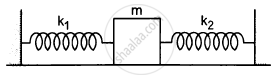
Both the springs shown in the following figure are unstretched. If the block is displaced by a distance x and released, what will be the initial acceleration?
A man has fallen into a ditch of width d and two of his friends are slowly pulling him out using a light rope and two fixed pulleys as shown in the following figure. Show that the force (assumed equal for both the friends) exerted by each friend on the road increases as the man moves up. Find the force when the man is at a depth h.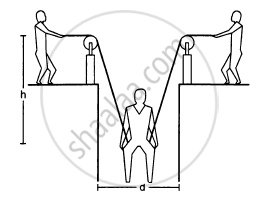
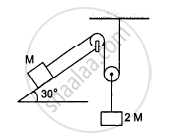
Find the acceleration of the block of mass M in the situation shown in the following figure. All the surfaces are frictionless and the pulleys and the string are light.
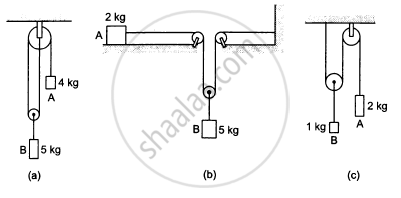
Find the acceleration of the blocks A and B in the three situations shown in the following figure.
Write the mathematical form of Newton's second law of motion. State the conditions if any.
What do you mean by an impulsive force?
In the previous problem (5.3), the magnitude of the momentum transferred during the hit is ______.
A hockey player is moving northward and suddenly turns westward with the same speed to avoid an opponent. The force that acts on the player is ______.
