Advertisements
Advertisements
प्रश्न
Calculate the velocity of a body of mass 0.5 kg, when it has a linear momentum of 5 Ns.
Advertisements
उत्तर
Mass of body = m = 0.5 kg
Linear momentum = P = 5 Ns
Velocity of body = v = ?
We know P = mv
v = `"P"/"m"=5/0.5`
v = 10 ms−1
APPEARS IN
संबंधित प्रश्न
A body of mass 0.40 kg moving initially with a constant speed of 10 m s–1 to the north is subject to a constant force of 8.0 N directed towards the south for 30 s. Take the instant the force is applied to be t = 0, the position of the body at that time to be x = 0, and predict its position at t = –5 s, 25 s, 100 s.
A block of mass 15 kg is placed on a long trolley. The coefficient of static friction between the block and the trolley is 0.18. The trolley accelerates from rest with 0.5 ms–2 for 20 s and then moves with uniform velocity. Discuss the motion of the block as viewed by (a) a stationary observer on the ground, (b) an observer moving with the trolley.
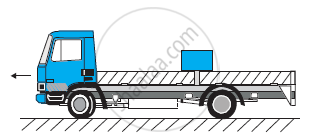
The rear side of a truck is open and a box of 40 kg mass is placed 5 m away from the open end as shown in Figure. The coefficient of friction between the box and the surface below it is 0.15. On a straight road, the truck starts from rest and accelerates with 2 m s–2. At what distance from the starting point does the box fall off the truck? (Ignore the size of the box).
An object is placed far away from all the objects that can exert force on it. A frame of reference is constructed by taking the origin and axes fixed in this object. Will the frame be necessarily inertial?
Show that the rate of change of momentum = mass × acceleration. Under what condition does this relation hold?
State the Newton's second law of motion. What information do you get from it?
ame the law of motion which gives the definition of force.
A stone is dropped from a cliff 98 m high.
How long will it take to fall to the foot of the cliff?
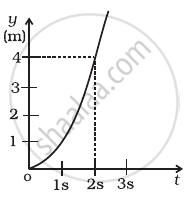
Figure shows (x, t), (y, t ) diagram of a particle moving in 2-dimensions.
|
|
 (b) |
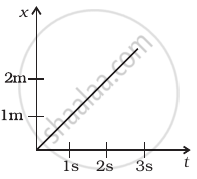
If the particle has a mass of 500 g, find the force (direction and magnitude) acting on the particle.
Why is catching a slow-moving ball easier than catching a fast-moving ball?
