Advertisements
Advertisements
प्रश्न
State the magnitude and direction of the force of gravity acting on the body of mass 5 kg. Take g = 9.8 m s-2.
Advertisements
उत्तर
Mass = 5 kg.
g = 9.8 m/s2.
Let F be the force of gravity,
F = mg.
F = (5) (9.8) = 49 N.
Force of gravity always acts downwards.
APPEARS IN
संबंधित प्रश्न
A smooth wedge A is fitted in a chamber hanging from a fixed ceiling near the earth's surface. A block B placed at the top of the wedge takes time T to slide down the length of the wedge. If the block is placed at the top of the wedge and the cable supporting the chamber is broken at the same instant, the block will.
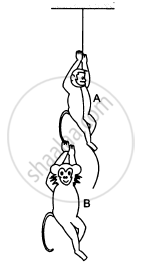
The monkey B, shown in the following figure, is holding on to the tail of monkey A that is climbing up a rope. The masses of monkeys A and B are 5 kg and 2 kg, respectively. If A can tolerate a tension of 30 N in its tail, what force should it apply on the rope in order to carry monkey B with it? Take g = 10 m/s2.
State the Newton's second law of motion. What information do you get from it?
State Newton's second law of motion. Under what condition does it take the form F = ma?
The linear momentum of a ball of mass 50 g is 0.5 kg m s-1. Find its velocity.
Multiple Choice Question. Select the correct option.
The impulse of a body is equal to:
State Newton's second law of motion. Is Newton's first law of motion contained in Newton's second law of motion?
What do you mean by linear momentum of a body? A force causes an acceleration of 10 ms-2 in a body of mass 1 kg. What acceleration will be caused by the same force in a body of mass 4 kg?
A stone is thrown vertically upward with a velocity of 9.8 m/s. When will it reach the ground?
Why does a child feel more pain when she falls down on a hard cement floor, than when she falls on the soft muddy ground in the garden?
