Advertisements
Advertisements
प्रश्न
A batsman deflects a ball by an angle of 45° without changing its initial speed which is equal to 54 km/h. What is the impulse imparted to the ball? (Mass of the ball is 0.15 kg.)
Advertisements
उत्तर
The given situation can be represented as shown in the following figure.
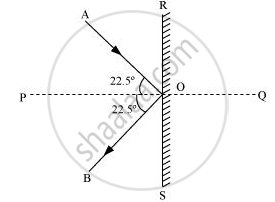
Where,
AO = Incident path of the ball
OB = Path followed by the ball after deflection
∠AOB = Angle between the incident and deflected paths of the ball = 45°
∠AOP = ∠BOP = 22.5° = θ
Initial and final velocities of the ball = v
Initial velocity's horizontal component = vcos θ along RO
Initial velocity's vertical component = vsin θ along PO
Final velocity's horizontal component = vcos θ along OS
Final velocity's vertical component = vsin θ along OP
The horizontal velocity components remain unchanged. The vertical velocity components are directed oppositely.
∴Impulse imparted to the ball = Change in the linear momentum of the ball
`= mvcostheta - (- mvcos theta)`
`= 2mvcos theta`
Mass of the ball, m = 0.15 kg
Velocity of the ball, v = 54 km/h = 15 m/s
∴ Impulse = 2 × 0.15 × 15 cos 22.5° = 4.16 kg m/s
APPEARS IN
संबंधित प्रश्न
A constant retarding force of 50 N is applied to a body of mass 20 kg moving initially with a speed of 15 ms–1. How long does the body take to stop?
A stone of mass m tied to the end of a string revolves in a vertical circle of radius R. The net forces at the lowest and highest points of the circle directed vertically downwards are: [Choose the correct alternative]
| Lowest Point | Highest Point | |
| a) | mg – T1 | mg + T2 |
| b) | mg + T1 | mg – T2 |
| c) | `mg + T1 –(m_v_1^2)/R` | mg – T2 + (`mv_1^2`)/R |
| d) | `mg – T1 – (mv)/R` | mg + T2 + (mv_1^2)/R |
T1 and v1 denote the tension and speed at the lowest point. T2 and v2 denote corresponding values at the highest point.
In a TV picture tube, electrons are ejected from the cathode with negligible speed and they attain a velocity of 5 × 10⁶ m/s in travelling one centimetre. Assuming straight-line motion, find the constant force exerted on the electrons. The mass of an electron is 9.1 × 10⁻³¹ kg.
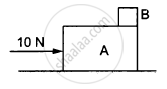
A small block B is placed on another block A of mass 5 kg and length 20 cm. Initially, the block B is near the right end of block A (In the following Figure). A constant horizontal force of 10 N is applied to the block A. All the surfaces are assumed frictionless. Find the time that elapses before block B separates from A.
The force of buoyancy exerted by the atmosphere on a balloon is B in the upward direction and remains constant. The force of air resistance on the balloon acts opposite the direction of velocity and is proportional to it. The balloon carries a mass M and is found to fall to the earth's surface with a constant velocity v. How much mass should be removed from the balloon so that it may rise with a constant velocity v?
Let m1 = 1 kg, m2 = 2 kg and m3 = 3 kg in the following figure. Find the accelerations of m1, m2 and m3. The string from the upper pulley to m1 is 20 cm when the system is released from rest. How long will it take before m1 strikes the pulley?
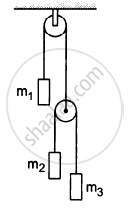
In the previous problem, suppose m2 = 2.0 kg and m3 = 3.0 kg. What should be the mass m, so that it remains at rest?
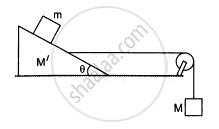
Find the mass M of the hanging block in the following figure that will prevent the smaller block from slipping over the triangular block. All the surfaces are frictionless and the strings and the pulleys are light.
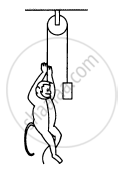
A monkey is climbing on a rope that goes over a smooth light pulley and supports a block of equal mass at the other end in the following figure. Show that whatever force the monkey exerts on the rope, the monkey and the block move in the same direction with equal acceleration. If initially both were at rest, their separation will not change as time passes.
Show that the rate of change of momentum = mass × acceleration. Under what condition does this relation hold?
How can Newton's first law of motion be obtained from the second law of motion?
The unit of linear momentum is :
The linear momentum of a ball of mass 50 g is 0.5 kg m s-1. Find its velocity.
A body of mass 200 g is moving with a velocity of 5 ms−1. If the velocity of the body changes to 17 ms−1, calculate the change in linear momentum of the body.
Multiple Choice Question. Select the correct option.
A force acts on a body of mass 3 kg such that its velocity changes from 4 ms−1 to 10 ms−1. The change in momentum of the body is
Multiple Choice Question. Select the correct option.
Which of the following are vector quantities?
What do you mean by linear momentum of a body? A force causes an acceleration of 10 ms-2 in a body of mass 1 kg. What acceleration will be caused by the same force in a body of mass 4 kg?
A stone is dropped from a tower 98 m high. With what speed should a second stone be thrown 1 s later so that both hit the ground at the same time?
A metre scale is moving with uniform velocity. This implies ______.
