Advertisements
Advertisements
प्रश्न
Explain why a cricketer moves his hands backwards while holding a catch.
Advertisements
उत्तर
According to Newton’s second law of motion, we have the equation of motion:
F = ma = `m (trianglev)/(trianglet)` ....(i)
Where
F = Stopping force experienced by the cricketer as he catches the ball
m = Mass of the ball
Δt = Time of impact of the ball with the hand
From equation (i), it is deducible that there is an inverse proportionality between the impact force and the impact time, i.e.
`F prop 1/(trianglet)` ......(ii)
Equation (ii) demonstrates that as the time of impact increases, the force experienced by the cricketer decreases and vice versa.
During a catch, a cricketer pulls his hands backward to lengthen the time of impact (Δt). This leads to a reduction in the stopping force, which helps protect the cricketer's hands from harm.
APPEARS IN
संबंधित प्रश्न
A helicopter of mass 1000 kg rises with a vertical acceleration of 15 m s–2. The crew and the passengers weigh 300 kg. Give the magnitude and direction of the
(a) force on the floor by the crew and passengers,
(b) action of the rotor of the helicopter on the surrounding air,
(c) force on the helicopter due to the surrounding air.
A car accelerates on a horizontal road due to the force exerted by.
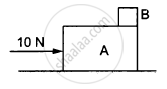
A small block B is placed on another block A of mass 5 kg and length 20 cm. Initially, the block B is near the right end of block A (In the following Figure). A constant horizontal force of 10 N is applied to the block A. All the surfaces are assumed frictionless. Find the time that elapses before block B separates from A.
A man has fallen into a ditch of width d and two of his friends are slowly pulling him out using a light rope and two fixed pulleys as shown in the following figure. Show that the force (assumed equal for both the friends) exerted by each friend on the road increases as the man moves up. Find the force when the man is at a depth h.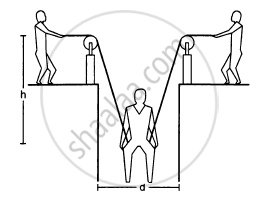
An empty plastic box of mass m is found to accelerate up at the rate of g/6 when placed deep inside water. How much sand should be put inside the box so that it may accelerate down at the rate of g/6?
In the previous problem, suppose m2 = 2.0 kg and m3 = 3.0 kg. What should be the mass m, so that it remains at rest?
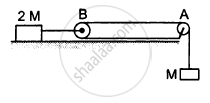
Consider the situation shown in the following figure. Both the pulleys and the string are light and all the surfaces are frictionless.
- Find the acceleration of the mass M.
- Find the tension in the string.
- Calculate the force exerted by the clamp on the pulley A in the figure.
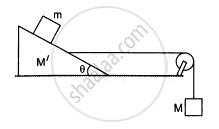
Find the mass M of the hanging block in the following figure that will prevent the smaller block from slipping over the triangular block. All the surfaces are frictionless and the strings and the pulleys are light.
Define linear momentum and state its S.I. unit.
Show that the rate of change of momentum = mass × acceleration. Under what condition does this relation hold?
Write the mathematical form of Newton's second law of motion. State the conditions if any.
How long will a stone take to fall to the ground from the top of a building 80 m high
Calculate the velocity of a body of mass 0.5 kg, when it has a linear momentum of 5 Ns.
State two factors which determine the momentum of a body.
Use Newton's second law to explain the following:
We always prefer to land on sand instead of hard floor while taking a high jump.
A stone is dropped from a cliff 98 m high.
How long will it take to fall to the foot of the cliff?
A ball is thrown vertically downward with an initial velocity of 10 m/s. What is its speed 1 s later and 2 s later?
In the previous problem (5.3), the magnitude of the momentum transferred during the hit is ______.
Why does a child feel more pain when she falls down on a hard cement floor, than when she falls on the soft muddy ground in the garden?
