Advertisements
Advertisements
प्रश्न
The linear momentum of a body of mass m moving with velocity v is :
पर्याय
v/m
m/v
mv
1/mv
Advertisements
उत्तर
The linear momentum of a body of mass m moving with velocity v is : mv
APPEARS IN
संबंधित प्रश्न
A block of mass 15 kg is placed on a long trolley. The coefficient of static friction between the block and the trolley is 0.18. The trolley accelerates from rest with 0.5 ms–2 for 20 s and then moves with uniform velocity. Discuss the motion of the block as viewed by (a) a stationary observer on the ground, (b) an observer moving with the trolley.
The figure shows the displacement of a particle going along the X-axis as a function of time. The force acting on the particle is zero in the region
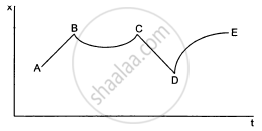
(a) AB
(b) BC
(c) CD
(d) DE
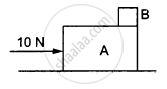
A small block B is placed on another block A of mass 5 kg and length 20 cm. Initially, the block B is near the right end of block A (In the following Figure). A constant horizontal force of 10 N is applied to the block A. All the surfaces are assumed frictionless. Find the time that elapses before block B separates from A.
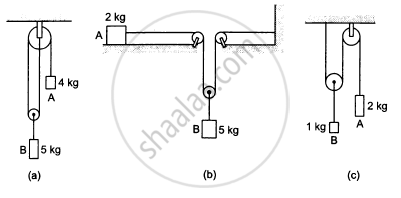
Find the acceleration of the blocks A and B in the three situations shown in the following figure.
Use Newton's second law of motion to explain the following instance :
An athlete prefers to land on sand instead of hard floor while taking a high jump .
A car is moving with a uniform velocity 30 ms-1. It is stopped in 2 s by applying a force of 1500 N through its brakes. Calculate the following values : The change in momentum of car.
A pebble is dropped freely in a well from its top. It takes 20 s for the pebble to reach the water surface in the well. Taking g = 10 m s-2 and speed of sound = 330 m s-1. Find : The time when echo is heard after the pebble is dropped.
Define Newton’s second law of motion.
A stone is thrown vertically upward with a velocity of 9.8 m/s. When will it reach the ground?
What do you mean by the conservation of momentum? Briefly, explain the collision between two bodies and the conservation of momentum.
