Advertisements
Advertisements
प्रश्न
What do you mean by the conservation of momentum? Briefly, explain the collision between two bodies and the conservation of momentum.
Advertisements
उत्तर
Conservation of momentum in case of a collision between two bodies means the total momentum before and after collision remains unchanged or conserved, provided no net force acts on the system.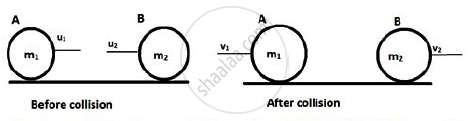
Consider two bodies A and 8 having masses m1 and m, and initial velocities u1 and u, respectively. The bodies collide head on with each other and their collision lasts for t seconds. Suppose the velocities of A and 8 after collision are v1 and v, respectively. Assume that no external forces are acting on the bodies.
Rate of change of momentum of ball A = m1(v1 - u1)/t .
Rate of change of momentum of ball 8 = m1 (v1 - u1)/t .
If FAB is the force exerted by A on 8 and FBA is the force ex
Rated by 8 on A, we can write
FAB= m1(v1 - u1)/t .
FBA = m1 (v1 - u1)/t .
FAB = -FBA
m1(v1 - u1)/t = - m2(v2- u2)/t .
m1(v1 - u1) = - m2(v2- u2)
m1v1 +m2v2 = m1u1+m2u2
So total momentum after collision = total momentum before collision.
This proves conservation of momentum during collision.
APPEARS IN
संबंधित प्रश्न
A batsman deflects a ball by an angle of 45° without changing its initial speed which is equal to 54 km/h. What is the impulse imparted to the ball? (Mass of the ball is 0.15 kg.)
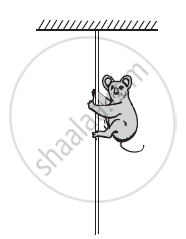
A monkey of mass 40 kg climbs on a rope in given Figure which can stand a maximum tension of 600 N. In which of the following cases will the rope break: the monkey
(a) climbs up with an acceleration of 6 m s–2
(b) climbs down with an acceleration of 4 m s–2
(c) climbs up with a uniform speed of 5 m s–1
(d) falls down the rope nearly freely under gravity?
(Ignore the mass of the rope).
Suppose you are running fast in a field and suddenly find a snake in front of you. You stop quickly. Which force is responsible for your deceleration?
A spy jumps from an airplane with his parachute. The spy accelerates downward for some time when the parachute opens. The acceleration is suddenly checked and the spy slowly falls to the ground. Explain the action of the parachute in checking the acceleration.
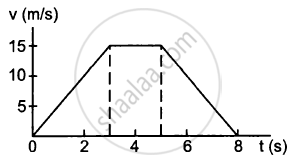
A particle of mass 50 g moves in a straight line. The variation of speed with time is shown in the following figure. Find the force acting on the particle at t = 2, 4 and 6 seconds.
In the previous problem, suppose m2 = 2.0 kg and m3 = 3.0 kg. What should be the mass m, so that it remains at rest?
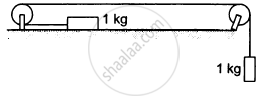
Calculate the tension in the string shown in the following figure. The pulley and the string are light and all the surfaces are frictionless. Take g = 10 m/s2.
A force of 10 N acts on a body of mass 2 kg for 3 s, initially at rest. Calculate : The velocity acquired by the body
What causes motion in a body?
What do you mean by an impulsive force?
