Advertisements
Advertisements
Question
What do you mean by the conservation of momentum? Briefly, explain the collision between two bodies and the conservation of momentum.
Advertisements
Solution
Conservation of momentum in case of a collision between two bodies means the total momentum before and after collision remains unchanged or conserved, provided no net force acts on the system.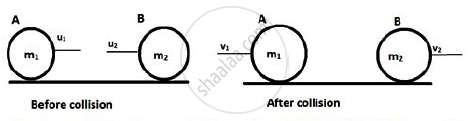
Consider two bodies A and 8 having masses m1 and m, and initial velocities u1 and u, respectively. The bodies collide head on with each other and their collision lasts for t seconds. Suppose the velocities of A and 8 after collision are v1 and v, respectively. Assume that no external forces are acting on the bodies.
Rate of change of momentum of ball A = m1(v1 - u1)/t .
Rate of change of momentum of ball 8 = m1 (v1 - u1)/t .
If FAB is the force exerted by A on 8 and FBA is the force ex
Rated by 8 on A, we can write
FAB= m1(v1 - u1)/t .
FBA = m1 (v1 - u1)/t .
FAB = -FBA
m1(v1 - u1)/t = - m2(v2- u2)/t .
m1(v1 - u1) = - m2(v2- u2)
m1v1 +m2v2 = m1u1+m2u2
So total momentum after collision = total momentum before collision.
This proves conservation of momentum during collision.
APPEARS IN
RELATED QUESTIONS
You are travelling in a car. The driver suddenly applies the brakes and you are pushed forward. Why does this happen?
An object is placed far away from all the objects that can exert force on it. A frame of reference is constructed by taking the origin and axes fixed in this object. Will the frame be necessarily inertial?
Two blocks A and B of mass mA and mB , respectively, are kept in contact on a frictionless table. The experimenter pushes block A from behind, so that the blocks accelerate. If block A exerts force F on block B, what is the force exerted by the experimenter on block A?
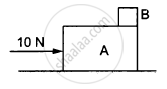
A small block B is placed on another block A of mass 5 kg and length 20 cm. Initially, the block B is near the right end of block A (In the following Figure). A constant horizontal force of 10 N is applied to the block A. All the surfaces are assumed frictionless. Find the time that elapses before block B separates from A.
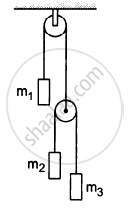
Let m1 = 1 kg, m2 = 2 kg and m3 = 3 kg in the following figure. Find the accelerations of m1, m2 and m3. The string from the upper pulley to m1 is 20 cm when the system is released from rest. How long will it take before m1 strikes the pulley?
Two balls A and B of masses m and 2 m are in motion with velocities 2v and v, respectively. Compare:
(i) Their inertia.
(ii) Their momentum.
(iii) The force needed to stop them in the same time.
State Newton's second law of motion. Under what condition does it take the form F = ma?
A force acts for 10 s on a stationary body of mass 100 kg, after which the force ceases to act. The body moves through a distance of 100 m in the next 5 s. Calculate : The magnitude of the force
Use Newton's second law to explain the following:
While catching a fast moving ball, we always pull our hands backwards.
Why is catching a slow-moving ball easier than catching a fast-moving ball?
