Advertisements
Advertisements
Question
A motorcycle of mass 100 kg is running at 10 ms−1. If its engine develops an extra linear momentum of 2000 Ns, calculate the new velocity of a motorcycle.
Advertisements
Solution
Mass of motor cycle = m = 100 kg
Velocity of motor cycle = v1= 10 ms−1
Momentum of motor cycle = mv1 = 100 × 10 = 1000 Ns
When engine develops an extra linear momentum of 2000 Ns
Then total momentum of motor cycle = 1000 + 2000 = 3000 Ns
Let v2 = new velocity of the motorcycle.
Total momentum of motor cycle = mv2
3000 = 100 × v2
v2 = `3000/100` = 30 ms−1
APPEARS IN
RELATED QUESTIONS
Explain why a cricketer moves his hands backwards while holding a catch.
When a horse pulls a cart, the force that helps the horse to move forward is the force exerted by
A person says that he measured the acceleration of a particle to be non-zero even though no force was acting on the particle.
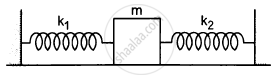
Both the springs shown in the following figure are unstretched. If the block is displaced by a distance x and released, what will be the initial acceleration?
Suppose the ceiling in the previous problem is that of an elevator which is going up with an acceleration of 2.0 m/s2. Find the elongation.
In the previous problem, suppose m2 = 2.0 kg and m3 = 3.0 kg. What should be the mass m, so that it remains at rest?
A force acts for 10 s on a stationary body of mass 100 kg, after which the force ceases to act. The body moves through a distance of 100 m in the next 5 s. Calculate: The velocity acquired by the body.
A ball is thrown vertically upwards. It returns 6 s later. Calculate the greatest height reached by the ball. (Take g = 10 m s−2)
A metre scale is moving with uniform velocity. This implies ______.
A hockey player is moving northward and suddenly turns westward with the same speed to avoid an opponent. The force that acts on the player is ______.
