Advertisements
Advertisements
Question
State Newton's second law of motion.
A body of mass 400 g is resting on a frictionless table. Find the acceleration of the body when acted upon by a force of 0.02 N.
Advertisements
Solution
According to Newton's second law of motion, when a force acts on a body, the rate of change in momentum of a body equals the product of the mass of the body and acceleration produced in it due to that force, provided the mass remains constant.
Mass of body = 400 g = 0.4kg
Force applied on body = 0.02 N
Acceleration = force/mass = 0.02/0.4 = 0.05 ms-2.
APPEARS IN
RELATED QUESTIONS
Two masses 8 kg and 12 kg are connected at the two ends of a light, inextensible string that goes over a frictionless pulley. Find the acceleration of the masses, and the tension in the string when the masses are released.
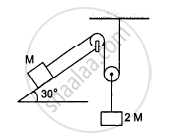
Find the acceleration of the block of mass M in the situation shown in the following figure. All the surfaces are frictionless and the pulleys and the string are light.
A monkey of mass 15 kg is climbing a rope fixed to a ceiling. If it wishes to go up with an acceleration of 1 m/s2, how much force should it apply on the rope? If the rope is 5 m long and the monkey starts from rest, how much time will it take to reach the ceiling?
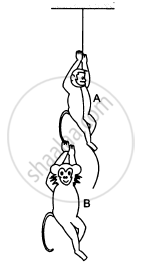
The monkey B, shown in the following figure, is holding on to the tail of monkey A that is climbing up a rope. The masses of monkeys A and B are 5 kg and 2 kg, respectively. If A can tolerate a tension of 30 N in its tail, what force should it apply on the rope in order to carry monkey B with it? Take g = 10 m/s2.
Two balls A and B of masses m and 2 m are in motion with velocities 2v and v, respectively. Compare:
(i) Their inertia.
(ii) Their momentum.
(iii) The force needed to stop them in the same time.
A pebble is thrown vertically upwards with a speed of 20 m s-1. How high will it be after 2 s? (Take g = 10 m s-2)
Calculate the velocity of a body of mass 0.5 kg, when it has a linear momentum of 5 Ns.
What do you understand by the term momentum?
In the previous problem (5.3), the magnitude of the momentum transferred during the hit is ______.
According to Newton's Second Law of Motion, what quantity is directly proportional to the applied force?
