Advertisements
Advertisements
प्रश्न
State Newton's second law of motion.
A body of mass 400 g is resting on a frictionless table. Find the acceleration of the body when acted upon by a force of 0.02 N.
Advertisements
उत्तर
According to Newton's second law of motion, when a force acts on a body, the rate of change in momentum of a body equals the product of the mass of the body and acceleration produced in it due to that force, provided the mass remains constant.
Mass of body = 400 g = 0.4kg
Force applied on body = 0.02 N
Acceleration = force/mass = 0.02/0.4 = 0.05 ms-2.
APPEARS IN
संबंधित प्रश्न
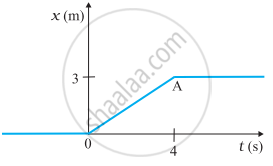
The below figure shows the position-time graph of a particle of mass 4 kg.
- What is the force on the particle for t < 0, t > 4 s, 0 < t < 4 s?
- What is the impulse at t = 0 and t = 4 s? (Consider one-dimensional motion only.)
A smooth wedge A is fitted in a chamber hanging from a fixed ceiling near the earth's surface. A block B placed at the top of the wedge takes time T to slide down the length of the wedge. If the block is placed at the top of the wedge and the cable supporting the chamber is broken at the same instant, the block will.
An empty plastic box of mass m is found to accelerate up at the rate of g/6 when placed deep inside water. How much sand should be put inside the box so that it may accelerate down at the rate of g/6?
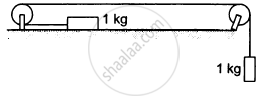
Calculate the tension in the string shown in the following figure. The pulley and the string are light and all the surfaces are frictionless. Take g = 10 m/s2.
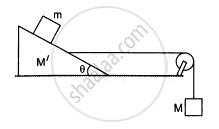
Find the mass M of the hanging block in the following figure that will prevent the smaller block from slipping over the triangular block. All the surfaces are frictionless and the strings and the pulleys are light.
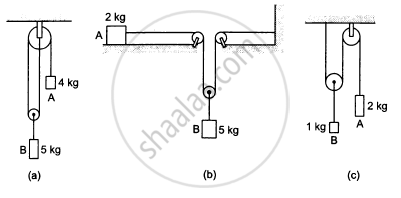
Find the acceleration of the blocks A and B in the three situations shown in the following figure.
The correct form of Newton's second law is :
ame the law of motion which gives the definition of force.
A stone is thrown vertically upward with a velocity of 9.8 m/s. When will it reach the ground?
In the previous problem (5.3), the magnitude of the momentum transferred during the hit is ______.
