Advertisements
Advertisements
प्रश्न
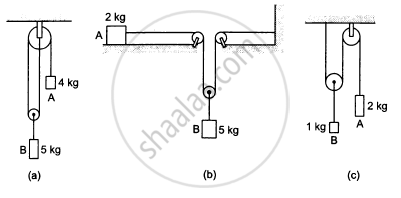
Find the acceleration of the blocks A and B in the three situations shown in the following figure.
Advertisements
उत्तर
(a) 5a + T − 5g = 0
From free-body diagram (1),
T = 5g − 5a .....(i)
Again,
\[\left( \frac{1}{2} \right)T - 4g - 8a = 0\]
⇒ T − 8g − 16a = 0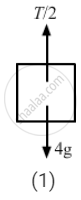
From free-body diagram (2),
T = 8g + 16a ......(ii)
From equations (i) and (ii), we get:
5g − 5a = 8g + 16a
\[\Rightarrow 21a = - 3g - a = - \frac{9}{7}\]
So, the acceleration of the 5 kg mass is \[\frac{9}{7} m/ s^2 \left(\text{ upward }\right)\] and that of the 4 kg mass is
\[2a = \frac{2g}{7} \left(\text{ downward }\right)\]
\[4a - \frac{T}{2} = 0\]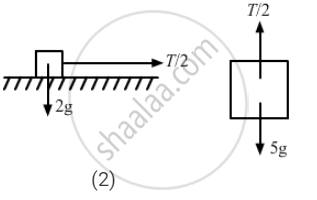
⇒ 8a − T = 0
⇒ T = 8a
Again, T + 5a − 5g = 0
From free body diagram-4,
8a + 5a − 5g = s0
⇒ 13a − 5g = 0
\[\Rightarrow a = \frac{5g}{13} \left(\text{ downward }\right)\]
Acceleration of mass 2 kg is \[2a = \frac{10}{13} \left( g \right)\] and 5 kg is
\[\frac{5g}{13}\].
(c) T + 1a − 1g = 0
From free body diagram-5
T = 1g − 1a .....(i)
Again, from free body diagram-6,
\[\frac{T}{2} - 2g - 4a = 0\]
⇒ T − 4g − 8a = 0 .....(ii)
From equation (i)
1g − 1a − 4g − 8a = 0
\[\Rightarrow a = \frac{g}{3}\left(\text{ downward }\right)\]
Acceleration of mass 1 kg is \[\frac{g}{3} \left(\text{ upward }\right)\]
Acceleration of mass 2 kg is \[\frac{2g}{3} \left(\text{ downward }\right)\] 
APPEARS IN
संबंधित प्रश्न
A helicopter of mass 1000 kg rises with a vertical acceleration of 15 m s–2. The crew and the passengers weigh 300 kg. Give the magnitude and direction of the
(a) force on the floor by the crew and passengers,
(b) action of the rotor of the helicopter on the surrounding air,
(c) force on the helicopter due to the surrounding air.
Two blocks A and B of mass mA and mB , respectively, are kept in contact on a frictionless table. The experimenter pushes block A from behind, so that the blocks accelerate. If block A exerts force F on block B, what is the force exerted by the experimenter on block A?
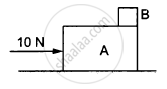
A small block B is placed on another block A of mass 5 kg and length 20 cm. Initially, the block B is near the right end of block A (In the following Figure). A constant horizontal force of 10 N is applied to the block A. All the surfaces are assumed frictionless. Find the time that elapses before block B separates from A.
A person is standing on a weighing machine placed on the floor of an elevator. The elevator starts going up with some acceleration, moves with uniform velocity for a while and finally decelerates to stop. The maximum and the minimum weights recorded are 72 kg and 60 kg, respectively. Assuming that the magnitudes of acceleration and deceleration are the same, find (a) the true weight of the person and (b) the magnitude of the acceleration. Take g = 9.9 m/s2.
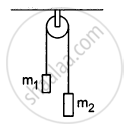
In a simple Atwood machine, two unequal masses m1 and m2 are connected by a string going over a clamped light smooth pulley. In a typical arrangement (In the following figure), m1 = 300 g and m2 = 600 g. The system is released from rest. (a) Find the distance travelled by the first block in the first two seconds; (b) find the tension in the string; (c) find the force exerted by the clamp on the pulley.
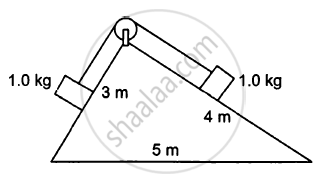
Consider the situation shown in the following figure All the surfaces are frictionless and the string and the pulley are light. Find the magnitude of acceleration of the two blocks.
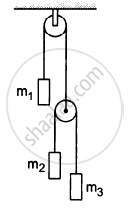
Let m1 = 1 kg, m2 = 2 kg and m3 = 3 kg in the following figure. Find the accelerations of m1, m2 and m3. The string from the upper pulley to m1 is 20 cm when the system is released from rest. How long will it take before m1 strikes the pulley?
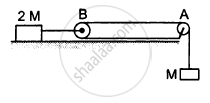
Consider the situation shown in the following figure. Both the pulleys and the string are light and all the surfaces are frictionless.
- Find the acceleration of the mass M.
- Find the tension in the string.
- Calculate the force exerted by the clamp on the pulley A in the figure.
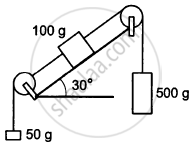
Find the acceleration of the 500 g block in the following figure.
An aeroplane is moving uniformly at a constant height under the action of two forces (i) Upward force (lift) and (ii) Downward force (weight). What is the net force on the aeroplane?
A tennis ball and a cricket ball , both are stationary. To start motion in them .
The unit of linear momentum is :
A bullet of mass 50 g moving with an initial velocity 100 m s-1 strikes a wooden block and comes to rest after penetrating a distance 2 cm in it. Calculate: (i) Initial momentum of the bullet, (ii) Final momentum of the bullet, (iii) Retardation caused by the wooden block and (iv) Resistive force exerted by the wooden block.
State the magnitude and direction of the force of gravity acting on the body of mass 5 kg. Take g = 9.8 m s-2.
Name the physical quantity which equals the rate of change of linear momentum.
A stone is thrown vertically upward with a velocity of 9.8 m/s. When will it reach the ground?
A cricket ball of mass 150 g has an initial velocity `u = (3hati + 4hatj)` m s−1 and a final velocity `v = - (3hati + 4hatj)` m s−1 after being hit. The change in momentum (final momentum-initial momentum) is (in kg m s1)
Why does a child feel more pain when she falls down on a hard cement floor, than when she falls on the soft muddy ground in the garden?
What happens when a car brakes to come to a stop?
