Newton’s Second Law corrected the old belief that force is needed to maintain motion. This idea came from the philosopher ______.
Advertisements
Advertisements
प्रश्न
An aircraft executes a horizontal loop at a speed of 720 km/h with its wings banked at 15°. What is the radius of the loop?
Advertisements
उत्तर १
Here v = 720 km/h = `720xx 5/18` m/s = 200 m/s and angle of banking `theta = 15^@`
From the relation
`tan theta = v^2/"rg"` we have
`r = v^2/(g tan theta) = (200xx200) /(10 xx tan 15^@) = (200xx200)/(10xx0.2679)`
=> r = 14931 m = 14.9 km
shaalaa.com
उत्तर २
Speed of the aircraft, v = 720 km/h = `720xx5/18 = 200` m/s
Acceleration due to gravity, g = 10 m/s2
Angle of banking, θ = 15°
For radius r, of the loop, we have the relation:
`tan theta = v^2/"rg"`
`r = v^2/(g tan theta)`
`= (200xx200)/(10xx tan 15) = 4000/0.268`
= 14925.37 m
= 14.92 km
shaalaa.com
या प्रश्नात किंवा उत्तरात काही त्रुटी आहे का?
संबंधित प्रश्न
Two masses 8 kg and 12 kg are connected at the two ends of a light, inextensible string that goes over a frictionless pulley. Find the acceleration of the masses, and the tension in the string when the masses are released.
A block of mass 0.2 kg is suspended from the ceiling by a light string. A second block of mass 0.3 kg is suspended from the first block by another string. Find the tensions in the two strings. Take g = 10 m/s2.
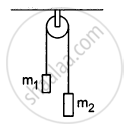
In a simple Atwood machine, two unequal masses m1 and m2 are connected by a string going over a clamped light smooth pulley. In a typical arrangement (In the following figure), m1 = 300 g and m2 = 600 g. The system is released from rest. (a) Find the distance travelled by the first block in the first two seconds; (b) find the tension in the string; (c) find the force exerted by the clamp on the pulley.
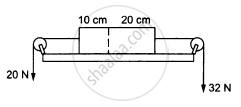
In the following figure shows a uniform rod of length 30 cm and mass 3.0 kg. The strings shown in the figure are pulled by constant forces of 20 N and 32 N. Find the force exerted by the 20 cm part of the rod on the 10 cm part. All the surfaces are smooth and the strings and the pulleys are light.
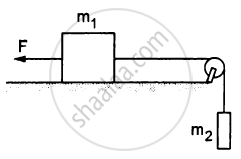
A constant force F = m2g/2 is applied on the block of mass m1 as shown in the following figure. The string and the pulley are light and the surface of the table is smooth. Find the acceleration of m1.
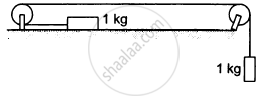
Calculate the tension in the string shown in the following figure. The pulley and the string are light and all the surfaces are frictionless. Take g = 10 m/s2.
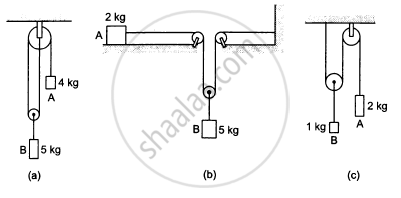
Find the acceleration of the blocks A and B in the three situations shown in the following figure.
State Newton's second law of motion. Under what condition does it take the form F = ma?
How can Newton's first law of motion be obtained from the second law of motion?
State the magnitude and direction of the force of gravity acting on the body of mass 5 kg. Take g = 9.8 m s-2.
A pebble is dropped freely in a well from its top. It takes 20 s for the pebble to reach the water surface in the well. Taking g = 10 m s-2 and speed of sound = 330 m s-1. Find : The depth of water surface
An electron of mass 9 × 10⁻³¹ kg is moving with a linear velocity of 6 × 10⁷ ms−1. Calculate the linear momentum of electron.
Multiple Choice Question. Select the correct option.
The impulse of a body is equal to:
Why is it advantageous to turn before taking a long jump?
Use Newton's second law to explain the following:
While catching a fast moving ball, we always pull our hands backwards.
A stone is dropped from a cliff 98 m high.
What will be its speed when it strikes the ground?
A stone is dropped from a tower 98 m high. With what speed should a second stone be thrown 1 s later so that both hit the ground at the same time?
The INCORRECT statement about Newton's second law of motion is
A cricket ball of mass 150 g has an initial velocity `u = (3hati + 4hatj)` m s−1 and a final velocity `v = - (3hati + 4hatj)` m s−1 after being hit. The change in momentum (final momentum-initial momentum) is (in kg m s1)
