Advertisements
Advertisements
प्रश्न
Use Newton's second law to explain the following:
We always prefer to land on sand instead of hard floor while taking a high jump.
Advertisements
उत्तर
We always prefer to land on sand instead of hard floor while taking a high jump because sand increases the time of contact.
As FX t = m ( v - u ) and our change in momentum is constant so if time increases then force experienced would decrease.
APPEARS IN
संबंधित प्रश्न
An aircraft executes a horizontal loop at a speed of 720 km/h with its wings banked at 15°. What is the radius of the loop?
A person drops a coin. Describe the path of the coin as seen by the person if he is in
- a car moving at constant velocity and
- in a free falling elevator.
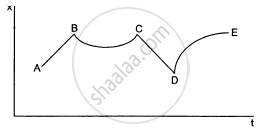
The figure shows the displacement of a particle going along the X-axis as a function of time. The force acting on the particle is zero in the region
(a) AB
(b) BC
(c) CD
(d) DE
State Newton's second law of motion. Under what condition does it take the form F = ma?
Use Newton's second law of motion to explain the following instance :
A cricketer pulls his hands back while catching a fast moving cricket ball .
Calculate the velocity of a body of mass 0.5 kg, when it has a linear momentum of 5 Ns.
ame the law of motion which gives the definition of force.
State Newton's second law of motion.
A body of mass 400 g is resting on a frictionless table. Find the acceleration of the body when acted upon by a force of 0.02 N.
What do you mean by linear momentum of a body? A force causes an acceleration of 10 ms-2 in a body of mass 1 kg. What acceleration will be caused by the same force in a body of mass 4 kg?
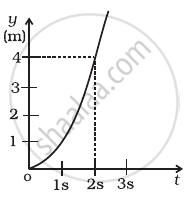
Figure shows (x, t), (y, t ) diagram of a particle moving in 2-dimensions.
|
|
 (b) |
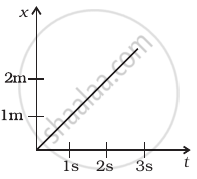
If the particle has a mass of 500 g, find the force (direction and magnitude) acting on the particle.
