Advertisements
Advertisements
प्रश्न
Use Newton's second law to explain the following:
While catching a fast moving ball, we always pull our hands backwards.
Advertisements
उत्तर
While catching a fast moving ball, we always pull our hands backwards to increase reaction time so force experienced would decrease.
APPEARS IN
संबंधित प्रश्न
A block of mass 15 kg is placed on a long trolley. The coefficient of static friction between the block and the trolley is 0.18. The trolley accelerates from rest with 0.5 ms–2 for 20 s and then moves with uniform velocity. Discuss the motion of the block as viewed by (a) a stationary observer on the ground, (b) an observer moving with the trolley.
A car accelerates on a horizontal road due to the force exerted by.
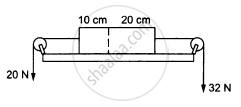
In the following figure shows a uniform rod of length 30 cm and mass 3.0 kg. The strings shown in the figure are pulled by constant forces of 20 N and 32 N. Find the force exerted by the 20 cm part of the rod on the 10 cm part. All the surfaces are smooth and the strings and the pulleys are light.
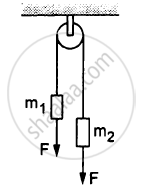
In the following figure, m1 = 5 kg, m2 = 2 kg and F = 1 N. Find the acceleration of either block. Describe the motion of m1 if the string breaks but F continues to act.
How can Newton's first law of motion be obtained from the second law of motion?
The linear momentum of a body of mass m moving with velocity v is :
What causes motion in a body?
Which of the following has the largest inertia?
A body of mass 2 kg travels according to the law x(t) = pt + qt2 + rt3 where p = 3 ms−1, q = 4 ms−2 and r = 5 ms−3. The force acting on the body at t = 2 seconds is ______.
Why is catching a slow-moving ball easier than catching a fast-moving ball?
