Advertisements
Advertisements
प्रश्न
State Newton's second law of motion. Under what condition does it take the form F = ma?
Advertisements
उत्तर
According to Newton's second law of motion, the rate of change of momentum is directly proportional to the force applied on it, and the change of momentum takes place in the direction in which the force is applied.
The relation F = ma holds for the following conditions:
(i) When the velocity of the body is much smaller than the velocity of light.
(ii) When the mass remains constant.
APPEARS IN
संबंधित प्रश्न
Explain why a cricketer moves his hands backwards while holding a catch.
When a horse pulls a cart, the force that helps the horse to move forward is the force exerted by
Two objects A and B are thrown upward simultaneously with the same speed. The mass of A is greater than that of B. Suppose the air exerts a constant and equal force of resistance on the two bodies.
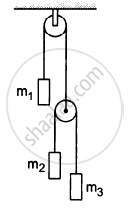
Let m1 = 1 kg, m2 = 2 kg and m3 = 3 kg in the following figure. Find the accelerations of m1, m2 and m3. The string from the upper pulley to m1 is 20 cm when the system is released from rest. How long will it take before m1 strikes the pulley?
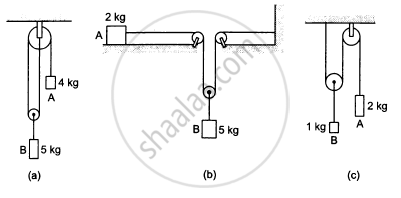
Find the acceleration of the blocks A and B in the three situations shown in the following figure.
A body of mass m moving with a velocity v is acted upon by a force. Write an expression for change in momentum in each of the following cases: (i) When v << c, (ii) When v → c and (iii) When v << c but m does not remain constant. Here, c is the speed of light.
State the Newton's second law of motion. What information do you get from it?
The unit of linear momentum is :
A force of 10 N acts on a body of mass 2 kg for 3 s, initially at rest. Calculate : The velocity acquired by the body
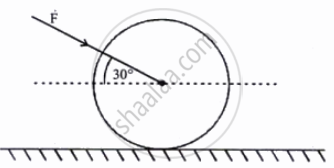
As shown in figure, a 70 kg garden roller is pushed with a force of F = 200 N at an angle of 30° with horizontal. The normal reaction on the roller is: (Given: g = 10 ms−2)