Advertisements
Advertisements
प्रश्न
State the Newton's second law of motion. What information do you get from it?
Advertisements
उत्तर
According to Newton's second law of motion, the rate of change of momentum is directly proportional to the force applied on it and the change of momentum takes place in the direction in which the force is applied.
It gives the quantitative value of force, i.e. it relates the force to the measurable quantities such as acceleration and mass.
APPEARS IN
संबंधित प्रश्न
If the tension in the cable supporting an elevator is equal to the weight of the elevator, the elevator may be
(a) going up with increasing speed
(b) going down with increasing speed
(c) going up with uniform speed
(d) going down with uniform speed
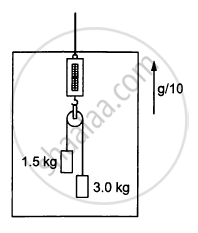
Find the reading of the spring balance shown in the following figure. The elevator is going up with an acceleration g/10, the pulley and the string are light and the pulley is smooth.
A block is kept on the floor of an elevator at rest. The elevator starts descending with an acceleration of 12 m/s2. Find the displacement of the block during the first 0.2 s after the start. Take g = 10 m/s2.
A force acts for 10 s on a stationary body of mass 100 kg, after which the force ceases to act. The body moves through a distance of 100 m in the next 5 s. Calculate : The magnitude of the force
State the magnitude and direction of the force of gravity acting on the body of mass 5 kg. Take g = 9.8 m s-2.
Name the physical quantity which equals the rate of change of linear momentum.
A ball is thrown vertically downward with an initial velocity of 10 m/s. What is its speed 1 s later and 2 s later?
A stone is dropped from a tower 98 m high. With what speed should a second stone be thrown 1 s later so that both hit the ground at the same time?
Why is catching a slow-moving ball easier than catching a fast-moving ball?
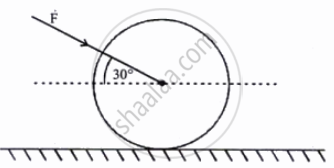
As shown in figure, a 70 kg garden roller is pushed with a force of F = 200 N at an angle of 30° with horizontal. The normal reaction on the roller is: (Given: g = 10 ms−2)