Advertisements
Advertisements
प्रश्न
How does Newton's second law of motion differ from the first law of motion?
Advertisements
उत्तर
Newton's first law of motion gives the qualitative definition of force. It explains the force as the cause of acceleration only qualitatively but Newton's second law of motion gives the quantitative value of force. It states force as the product of mass and acceleration. Thus, it relates force to the measurable quantities such as acceleration and mass.
APPEARS IN
संबंधित प्रश्न
If the speed of the stone is increased beyond the maximum permissible value, and the string breaks suddenly, which of the following correctly describes the trajectory of the stone after the string breaks?
A moving bicycle comes to rest after sometime if we stop pedalling it. But Newton’s first law of motion says that a moving body should continue to move for ever, unless some external force acts on it. How do you explain the bicycle case ?
Find the acceleration produced by a force of 5 N acting on a mass of 10 kg.
The acceleration of a particle is zero, as measured from an inertial frame of reference. Can we conclude that no force acts on the particle?
When a train starts, the head of a standing passenger seems to be pushed backward. Analyse the situation from the ground frame. Does it really go backward? Coming back to the train frame, how do you explain the backward movement of the head on the basis of Newton's laws?
State Newton's first law of motion.
If a 5 N and a 15 N forces are acting opposite to one another. Find the resultant force and the direction of action of the resultant force.
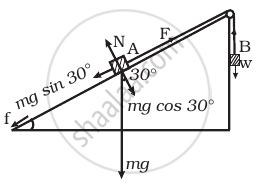
Block A of weight 100 N rests on a frictionless inclined plane of slope angle 30° (figure). A flexible cord attached to A passes over a frictonless pulley and is connected to block B of weight W. Find the weight W for which the system is in equilibrium.
In a legend, the hero-kid kicked a toy pig so that it is projected with a speed greater than that of its cry. If the weight of the toy pig is assumed to be 5 kg and the time of contact 0.01 sec., the force with which the hero-kid kicked him was ______.
(Speed of cry = 330 m/s)
When does an object accelerate?
