Advertisements
Advertisements
प्रश्न
The force exerted by the floor of an elevator on the foot of a person is more than the weight of the person if the elevator is
(a) going up and slowing down
(b) going up and speeding up
(c) going down and slowing down
(d) going down and speeding up
Advertisements
उत्तर
(b) going up and speeding up
(c) going down and slowing down
It means normal force exerted by the floor of the elevator on the person is greater that the weight of the person.
i.e. N > mg
(i) Going up and speeding up:
aeff = g + a
N = maeff = mg + ma (N > mg)
(ii) Going down and speeding up:
aeff = g – a
N = mg – ma (N < mg)
(iii) Going down and slowing down:
aeff = g – (–a) = g + a
N = mg + ma (N > mg)
(iv) Going up and slowing down:
aeff = g – a
N = mg – ma (N < mg)
APPEARS IN
संबंधित प्रश्न
A batsman hits a cricket ball which then rolls on a level ground. After covering a short distance, the ball comes to rest. The ball slows to a stop because ______.
What is the other name of Newton’s first law of motion ?
Define one newton force.
Name the physical quantity whose unit is ‘newton’.
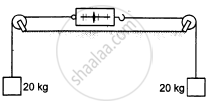
The figure shows a light spring balance connected to two blocks of mass 20 kg each. The graduations in the balance measure the tension in the spring. (a) What is the reading of the balance? (b) Will the reading change if the balance is heavy, say 2.0 kg? (c) What will happen if the spring is light but the blocks have unequal masses?
Consider a book lying on a table. The weight of the book and the normal force by the table in the book are equal in magnitude and opposite in direction. Is this an example of Newton's third law?
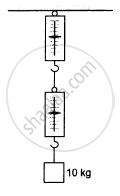
A block of mass 10 kg is suspended from two light spring balances, as shown in the following figure.
A particle stays at rest as seen in a frame. We can conclude that
(a) the frame is inertial
(b) resultant force on the particle is zero
(c) the frame may be inertial but the resultant force on the particle is zero
(d) the frame may be non-inertial but there is a non-zero resultant force
A particle is found to be at rest when seen from a frame S1 and moving with constant velocity when seen from another frame S2. Mark out the possible options.
(a) Both the frames are inertial.
(b) Both the frames are non-inertial.
(c) S1 is inertial and S2 is non-inertial.
(d) S1 is non-inertial and S2 is inertial
An object of mass 2 kg is sliding with a constant velocity of 4 m/s on a frictionless horizontal table. The force required to keep this object moving with the same velocity is :
State and explain the law of inertia (or Newton's first law of motion).
A force of 600 dynes acts on a glass ball of mass 200 g for 12 s. If initially, the ball is at rest, find
- Final velocity
- Distance covered.
The amount of inertia of a body depends on its _________.
A man riding on a car has ___________ Inertia.
Name the scientist who first stated the law of inertia.
Differentiate between gravitational mass and inertial mass.
A car of mass m starts from rest and acquires a velocity along east `v = vhati (v > 0)` in two seconds. Assuming the car moves with uniform acceleration, the force exerted on the car is ______.
The masses of 10 kg and 20 kg, respectively, are connected by massless spring as shown in the figure. A force of 200 N acts on the 20 kg mass. At the instant shown, the 10 kg mass has acceleration of 12 m/s2. What is the acceleration of 20 kg mass?
(g = 10 m/s2)

If the net force on an object is zero, what happens?
How is force defined according to Newton’s First Law?
