Advertisements
Advertisements
प्रश्न
In an imaginary atmosphere, the air exerts a small force F on any particle in the direction of the particle's motion. A particle of mass m projected upward takes time t1 in reaching the maximum height and t2 in the return journey to the original point. Then.
पर्याय
t1 < t2
t1 > t2
t1 = t2
the relation between t1 and t2 depends on the mass of the particle
Advertisements
उत्तर
t1 > t2
Let acceleration due to air resistance force be a.
Let H be maximum height attained by the particle.
Direction of air resistance force is in the direction of motion.
In the upward direction of motion,
\[a_{eff} = \left| g - a \right|\]
\[t_1 = \sqrt{\frac{2H}{\left| g - a \right|}} . . . (1)\]
In the downward direction of motion,
\[a_{eff} = g + a\]
\[t_2 = \sqrt{\frac{2H}{g + a}} . . . (2)\]
So, t1 > t2.
APPEARS IN
संबंधित प्रश्न
The driver of a three-wheeler moving with a speed of 36 km/h sees a child standing in the middle of the road and brings his vehicle to rest in 4.0 s just in time to save the child. What is the average retarding force on the vehicle? The mass of the three-wheeler is 400 kg and the mass of the driver is 65 kg.
Define one newton force.
Find the acceleration produced by a force of 5 N acting on a mass of 10 kg.
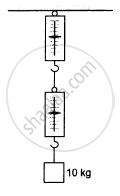
A block of mass 10 kg is suspended from two light spring balances, as shown in the following figure.
Three rigid rods are joined to form an equilateral triangle ABC of side 1 m. Three particles carrying charges 20 μC each are attached to the vertices of the triangle. The whole system is at rest in an inertial frame. The magnitude of the resultant force on the charged particle at A is.
A block of 2 kg is suspended from a ceiling by a massless spring of spring constant k = 100 N/m. What is the elongation of the spring? If another 1 kg is added to the block, what would be the further elongation?
If you jump barefoot on a hard surface, your legs are injured. But they are not injured if you jump on a soft surface like sand or pillow. Why?
When a train starts, the head of a standing passenger seems to be pushed backward. Analyse the situation from the ground frame. Does it really go backward? Coming back to the train frame, how do you explain the backward movement of the head on the basis of Newton's laws?
State Newton's first law of motion.
How does Newton's second law of motion differ from the first law of motion?
The amount of inertia of a body depends on its _________.
Give two examples of the following:
Inertia of rest
Match the following
| Column I | Column II |
| Newton’s I law | propulsion of a rocket |
| Newton’s II law | Stable equilibrium of a body |
| Newton’s III law | Law of force |
| Law of conservation of linear momentum | Flying nature of bird |
In a legend, the hero-kid kicked a toy pig so that it is projected with a speed greater than that of its cry. If the weight of the toy pig is assumed to be 5 kg and the time of contact 0.01 sec., the force with which the hero-kid kicked him was ______.
(Speed of cry = 330 m/s)
Two blocks A and B of masses m and 2 m, respectively, are held at rest such that the spring is in natural length. Find out the accelerations of both the blocks just after release.

Match the following.
| Column I | Column II |
| a. Newton’s I law | propulsion of a rocket |
| b. Newton’s II law | Stable equilibrium of the body |
| c. Newton’s III law | Law of force |
| d. Law of conservation of Linear momentum | Flying nature of bird |
If the net force on an object is zero, what happens?
An insect is at the bottom of a hemispherical ditch of radius 1 m. It crawls up the ditch but starts slipping after it is at height h from the bottom. If the coefficient of friction between the ground and the insect is 0.75, then h is ______. (g = 10 ms−2)
An interstellar spacecraft, far away from the influence of any star or planet, is moving at high speed under the influence of fusion rockets (due to the thrust exerted by fusion rockets, the spacecraft is accelerating). Suddenly the engine malfunctions and stops. The spacecraft will ______.
