Advertisements
Advertisements
प्रश्न
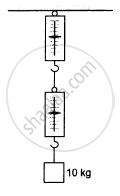
A block of mass 10 kg is suspended from two light spring balances, as shown in the following figure.
पर्याय
Both the scales will read 10 kg.
Both the scales will read 5 kg.
The upper scale will read 10 kg and the lower zero.
The readings may be anything but their sums will be 10 kg.
Advertisements
उत्तर
Both the scales will read 10 kg.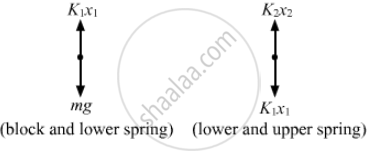
From the free-body diagram
K1x1 = mg = 10 x 9.8 = 98 N
K2x2 = K1x1
So, K1x1 = K2x2 = 98 N
Therefore, both the spring balances will read the same mass, i.e. 10 kg.
APPEARS IN
संबंधित प्रश्न
If the speed of the stone is increased beyond the maximum permissible value, and the string breaks suddenly, which of the following correctly describes the trajectory of the stone after the string breaks?
What is the other name of Newton’s first law of motion ?
Fill in the following blank with suitable word :
Newton’s first law of motion is also called Galileo’s law of ………………………
Is it possible for a particle to describe a curved path if no force acts on it? Does your answer depend on the frame of reference chosen to view the particle?
The acceleration of a particle is zero, as measured from an inertial frame of reference. Can we conclude that no force acts on the particle?
Neglect the effect of rotation of the earth. Suppose the earth suddenly stops attracting objects placed near its surface. A person standing on the surface of the earth will.
Three rigid rods are joined to form an equilateral triangle ABC of side 1 m. Three particles carrying charges 20 μC each are attached to the vertices of the triangle. The whole system is at rest in an inertial frame. The magnitude of the resultant force on the charged particle at A is.
In an imaginary atmosphere, the air exerts a small force F on any particle in the direction of the particle's motion. A particle of mass m projected upward takes time t1 in reaching the maximum height and t2 in the return journey to the original point. Then.
The force exerted by the floor of an elevator on the foot of a person is more than the weight of the person if the elevator is
(a) going up and slowing down
(b) going up and speeding up
(c) going down and slowing down
(d) going down and speeding up
A block of mass 2 kg placed on a long frictionless horizontal table is pulled horizontally by a constant force F. It is found to move 10 m in the first seconds. Find the magnitude of F.
If you jump barefoot on a hard surface, your legs are injured. But they are not injured if you jump on a soft surface like sand or pillow. Why?
State Newton's first law of motion.
State and explain the law of inertia (or Newton's first law of motion).
Give qualitative definition of force on the basic of Newton's first law of motion.
Newton's first law of motion describes ______.
Two blocks A and B of masses m and 2 m, respectively, are held at rest such that the spring is in natural length. Find out the accelerations of both the blocks just after release.

This question has Statement 1 and Statement 2. Of the four choices given after the Statements, choose the one that best describes the two Statements.
Statement 1: If you push on a cart being pulled by a horse so that it does not move, the cart pushes you back with an equal and opposite force.
Statement 2: The cart does not move because the force described in statement 1 cancel each other.
An insect is at the bottom of a hemispherical ditch of radius 1 m. It crawls up the ditch but starts slipping after it is at height h from the bottom. If the coefficient of friction between the ground and the insect is 0.75, then h is ______. (g = 10 ms−2)
