Advertisements
Advertisements
Question
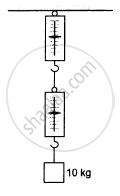
A block of mass 10 kg is suspended from two light spring balances, as shown in the following figure.
Options
Both the scales will read 10 kg.
Both the scales will read 5 kg.
The upper scale will read 10 kg and the lower zero.
The readings may be anything but their sums will be 10 kg.
Advertisements
Solution
Both the scales will read 10 kg.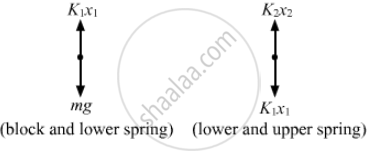
From the free-body diagram
K1x1 = mg = 10 x 9.8 = 98 N
K2x2 = K1x1
So, K1x1 = K2x2 = 98 N
Therefore, both the spring balances will read the same mass, i.e. 10 kg.
APPEARS IN
RELATED QUESTIONS
When a carpet is beaten with a stick, dust comes out of it. Explain.
The driver of a three-wheeler moving with a speed of 36 km/h sees a child standing in the middle of the road and brings his vehicle to rest in 4.0 s just in time to save the child. What is the average retarding force on the vehicle? The mass of the three-wheeler is 400 kg and the mass of the driver is 65 kg.
Name the scientist who gave the laws of motion.
Name the physical quantity whose unit is ‘newton’.
Find the acceleration produced by a force of 5 N acting on a mass of 10 kg.
Name the law involved in the following situation :
if there were no friction and no air resistance, then a moving bicycle would go on moving for ever.
The acceleration of a particle is zero, as measured from an inertial frame of reference. Can we conclude that no force acts on the particle?
Three rigid rods are joined to form an equilateral triangle ABC of side 1 m. Three particles carrying charges 20 μC each are attached to the vertices of the triangle. The whole system is at rest in an inertial frame. The magnitude of the resultant force on the charged particle at A is.
A reference frame attached to the earth
(a) is an inertial frame by definition
(b) cannot be an inertial frame because the earth is revolving around the sun
(c) is an inertial frame because Newton's laws are applicable in this frame
(d) cannot be an inertial frame because the earth is rotating about its axis.
A particle is found to be at rest when seen from a frame S1 and moving with constant velocity when seen from another frame S2. Mark out the possible options.
(a) Both the frames are inertial.
(b) Both the frames are non-inertial.
(c) S1 is inertial and S2 is non-inertial.
(d) S1 is non-inertial and S2 is inertial
When a train starts, the head of a standing passenger seems to be pushed backward. Analyse the situation from the ground frame. Does it really go backward? Coming back to the train frame, how do you explain the backward movement of the head on the basis of Newton's laws?
State and explain the law of inertia (or Newton's first law of motion).
What do you mean by inertia of motion?
The greater is the __________ the greater is the inertia of an object.
What do you mean by inertia of rest?
Name the scientist who first stated the law of inertia.
In a legend, the hero-kid kicked a toy pig so that it is projected with a speed greater than that of its cry. If the weight of the toy pig is assumed to be 5 kg and the time of contact 0.01 sec., the force with which the hero-kid kicked him was ______.
(Speed of cry = 330 m/s)
An insect is at the bottom of a hemispherical ditch of radius 1 m. It crawls up the ditch but starts slipping after it is at height h from the bottom. If the coefficient of friction between the ground and the insect is 0.75, then h is ______. (g = 10 ms−2)
