Advertisements
Advertisements
Question
In an imaginary atmosphere, the air exerts a small force F on any particle in the direction of the particle's motion. A particle of mass m projected upward takes time t1 in reaching the maximum height and t2 in the return journey to the original point. Then.
Options
t1 < t2
t1 > t2
t1 = t2
the relation between t1 and t2 depends on the mass of the particle
Advertisements
Solution
t1 > t2
Let acceleration due to air resistance force be a.
Let H be maximum height attained by the particle.
Direction of air resistance force is in the direction of motion.
In the upward direction of motion,
\[a_{eff} = \left| g - a \right|\]
\[t_1 = \sqrt{\frac{2H}{\left| g - a \right|}} . . . (1)\]
In the downward direction of motion,
\[a_{eff} = g + a\]
\[t_2 = \sqrt{\frac{2H}{g + a}} . . . (2)\]
So, t1 > t2.
APPEARS IN
RELATED QUESTIONS
When a carpet is beaten with a stick, dust comes out of it. Explain.
Fill in the following blank with suitable word :
Newton’s first law of motion is also called Galileo’s law of ………………………
State Newton’s first law of motion. Give two examples to illustrate Newton’s first law of motion.
Find the acceleration produced by a force of 5 N acting on a mass of 10 kg.
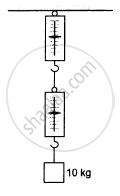
A block of mass 10 kg is suspended from two light spring balances, as shown in the following figure.
A reference frame attached to the earth
(a) is an inertial frame by definition
(b) cannot be an inertial frame because the earth is revolving around the sun
(c) is an inertial frame because Newton's laws are applicable in this frame
(d) cannot be an inertial frame because the earth is rotating about its axis.
An object of mass 2 kg is sliding with a constant velocity of 4 m/s on a frictionless horizontal table. The force required to keep this object moving with the same velocity is :
Derive the relation between newton and dyne.
Name the different kinds of inertia an object can possess. Give an example of each.
The amount of inertia of a body depends on its _________.
Give two examples of the following:
Inertia of rest
Name the scientist who first stated the law of inertia.
Differentiate between gravitational mass and inertial mass.
Classify the types of force based on their application.
Newton's first law of motion describes ______.
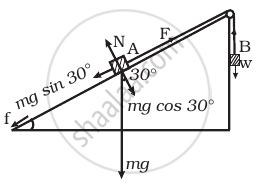
Block A of weight 100 N rests on a frictionless inclined plane of slope angle 30° (figure). A flexible cord attached to A passes over a frictonless pulley and is connected to block B of weight W. Find the weight W for which the system is in equilibrium.
A balloon has mass of 10 g in air. The air escapes from the balloon at a uniform rate with velocity 4.5 cm/s. If the balloon shrinks in 5 s completely. Then, the average force acting on that balloon will be (in dyne).
This question has Statement 1 and Statement 2. Of the four choices given after the Statements, choose the one that best describes the two Statements.
Statement 1: If you push on a cart being pulled by a horse so that it does not move, the cart pushes you back with an equal and opposite force.
Statement 2: The cart does not move because the force described in statement 1 cancel each other.
What is the significance of Newton’s first law?
An interstellar spacecraft, far away from the influence of any star or planet, is moving at high speed under the influence of fusion rockets (due to the thrust exerted by fusion rockets, the spacecraft is accelerating). Suddenly the engine malfunctions and stops. The spacecraft will ______.
