Advertisements
Advertisements
Question
A particle is found to be at rest when seen from a frame S1 and moving with constant velocity when seen from another frame S2. Mark out the possible options.
(a) Both the frames are inertial.
(b) Both the frames are non-inertial.
(c) S1 is inertial and S2 is non-inertial.
(d) S1 is non-inertial and S2 is inertial
Advertisements
Solution
(a) Both the frames are inertial.
(b) Both the frames are non-inertial.
S1 is moving with constant velocity w.r.t frame S2. So, if S1 is inertial, then S2 will be inertial and if S1 is non-inertial, then S2 will be non-inertial.
APPEARS IN
RELATED QUESTIONS
The driver of a three-wheeler moving with a speed of 36 km/h sees a child standing in the middle of the road and brings his vehicle to rest in 4.0 s just in time to save the child. What is the average retarding force on the vehicle? The mass of the three-wheeler is 400 kg and the mass of the driver is 65 kg.
If the speed of the stone is increased beyond the maximum permissible value, and the string breaks suddenly, which of the following correctly describes the trajectory of the stone after the string breaks?
Name the scientist who gave the laws of motion.
Name the law involved in the following situation :
if there were no friction and no air resistance, then a moving bicycle would go on moving for ever.
A plumb bob is hung from the ceiling of a train compartment. If the train moves with an acceleration 'a' along a straight horizontal track , the string supporting the bob makes an angle tan−1 (a/g) with the normal to the ceiling. Suppose the train moves on an inclined straight track with uniform velocity. If the angle of incline is tan−1 (a/g), the string again makes the same angle with the normal to the ceiling. Can a person sitting inside the compartment tell by looking at the plumb line whether the train is accelerating on a horizontal straight track or moving on an incline? If yes, how? If not, then suggest a method to do so.
A particle is observed from two frames S1 and S2. Frame S2 moves with respect to S1with an acceleration a. Let F1 and F2 be the pseudo forces on the particle when seen from S1 and S2, respectively. Which of the following is not possible?
If you jump barefoot on a hard surface, your legs are injured. But they are not injured if you jump on a soft surface like sand or pillow. Why?
An object of mass 2 kg is sliding with a constant velocity of 4 m/s on a frictionless horizontal table. The force required to keep this object moving with the same velocity is :
A man riding on a car has ___________ Inertia.
What do you mean by inertia of rest?
When a bus suddenly takes a tum, the passengers are thrown outwards because of
Newton's first law of motion describes ______.
A body of mass 10 kg is acted upon by two perpendicular forces, 6 N and 8 N. The resultant acceleration of the body is ______.
- 1 m s–2 at an angle of tan−1 `(4/3)` w.r.t 6 N force.
- 0.2 m s–2 at an angle of tan−1 `(4/3)` w.r.t 6 N force.
- 1 m s–2 at an angle of tan−1 `(3/4)` w.r.t 8 N force.
- 0.2 m s–2 at an angle of tan−1 `(3/4)` w.r.t 8 N force.
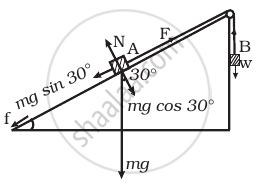
Block A of weight 100 N rests on a frictionless inclined plane of slope angle 30° (figure). A flexible cord attached to A passes over a frictonless pulley and is connected to block B of weight W. Find the weight W for which the system is in equilibrium.
In a legend, the hero-kid kicked a toy pig so that it is projected with a speed greater than that of its cry. If the weight of the toy pig is assumed to be 5 kg and the time of contact 0.01 sec., the force with which the hero-kid kicked him was ______.
(Speed of cry = 330 m/s)
This question has Statement 1 and Statement 2. Of the four choices given after the Statements, choose the one that best describes the two Statements.
Statement 1: If you push on a cart being pulled by a horse so that it does not move, the cart pushes you back with an equal and opposite force.
Statement 2: The cart does not move because the force described in statement 1 cancel each other.
If the net force on an object is zero, what happens?
An interstellar spacecraft, far away from the influence of any star or planet, is moving at high speed under the influence of fusion rockets (due to the thrust exerted by fusion rockets, the spacecraft is accelerating). Suddenly the engine malfunctions and stops. The spacecraft will ______.
