Advertisements
Advertisements
Question
A particle stays at rest as seen in a frame. We can conclude that
(a) the frame is inertial
(b) resultant force on the particle is zero
(c) the frame may be inertial but the resultant force on the particle is zero
(d) the frame may be non-inertial but there is a non-zero resultant force
Advertisements
Solution
(c) the frame may be inertial but the resultant force on the particle is zero
(d) the frame may be non-inertial but there is a non-zero resultant force
According to Newton's second law which says that net force acting on the particle is equal to rate of change of momentum ( or mathematically F = ma), so if a particle is at rest then Fnet = ma = m\[\frac{d v}{d t} = m\frac{d (0)}{d t} = m \times 0 = 0\]
Now, if the frame is inertial, then the resultant force on the particle is zero.
If the frame is non-inertial,
vector sum of all the forces plus a pseudo force is zero.
i.e. Fnet ≠ 0.
APPEARS IN
RELATED QUESTIONS
The driver of a three-wheeler moving with a speed of 36 km/h sees a child standing in the middle of the road and brings his vehicle to rest in 4.0 s just in time to save the child. What is the average retarding force on the vehicle? The mass of the three-wheeler is 400 kg and the mass of the driver is 65 kg.
If the speed of the stone is increased beyond the maximum permissible value, and the string breaks suddenly, which of the following correctly describes the trajectory of the stone after the string breaks?
What is the other name of Newton’s first law of motion ?
Fill in the following blank with suitable word :
Newton’s first law of motion is also called Galileo’s law of ………………………
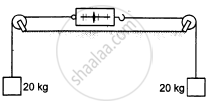
The figure shows a light spring balance connected to two blocks of mass 20 kg each. The graduations in the balance measure the tension in the spring. (a) What is the reading of the balance? (b) Will the reading change if the balance is heavy, say 2.0 kg? (c) What will happen if the spring is light but the blocks have unequal masses?
Neglect the effect of rotation of the earth. Suppose the earth suddenly stops attracting objects placed near its surface. A person standing on the surface of the earth will.
The force exerted by the floor of an elevator on the foot of a person is more than the weight of the person if the elevator is
(a) going up and slowing down
(b) going up and speeding up
(c) going down and slowing down
(d) going down and speeding up
A particle is observed from two frames S1 and S2. Frame S2 moves with respect to S1with an acceleration a. Let F1 and F2 be the pseudo forces on the particle when seen from S1 and S2, respectively. Which of the following is not possible?
If you jump barefoot on a hard surface, your legs are injured. But they are not injured if you jump on a soft surface like sand or pillow. Why?
A man riding on a car has ___________ Inertia.
Classify the types of force based on their application.
A body of mass 10 kg is acted upon by two perpendicular forces, 6 N and 8 N. The resultant acceleration of the body is ______.
- 1 m s–2 at an angle of tan−1 `(4/3)` w.r.t 6 N force.
- 0.2 m s–2 at an angle of tan−1 `(4/3)` w.r.t 6 N force.
- 1 m s–2 at an angle of tan−1 `(3/4)` w.r.t 8 N force.
- 0.2 m s–2 at an angle of tan−1 `(3/4)` w.r.t 8 N force.
This question has Statement 1 and Statement 2. Of the four choices given after the Statements, choose the one that best describes the two Statements.
Statement 1: If you push on a cart being pulled by a horse so that it does not move, the cart pushes you back with an equal and opposite force.
Statement 2: The cart does not move because the force described in statement 1 cancel each other.
Match the following.
| Column I | Column II |
| a. Newton’s I law | propulsion of a rocket |
| b. Newton’s II law | Stable equilibrium of the body |
| c. Newton’s III law | Law of force |
| d. Law of conservation of Linear momentum | Flying nature of bird |
What is the significance of Newton’s first law?
When does an object accelerate?
An insect is at the bottom of a hemispherical ditch of radius 1 m. It crawls up the ditch but starts slipping after it is at height h from the bottom. If the coefficient of friction between the ground and the insect is 0.75, then h is ______. (g = 10 ms−2)
An interstellar spacecraft, far away from the influence of any star or planet, is moving at high speed under the influence of fusion rockets (due to the thrust exerted by fusion rockets, the spacecraft is accelerating). Suddenly the engine malfunctions and stops. The spacecraft will ______.
