Advertisements
Advertisements
Question
Give two examples of the following:
Inertia of motion
Advertisements
Solution
A ball rolling on the ground will continue to roll unless the external force , the force of friction between the ball and the ground stops it.This is an example of inertia of motion.
APPEARS IN
RELATED QUESTIONS
A moving bicycle comes to rest after sometime if we stop pedalling it. But Newton’s first law of motion says that a moving body should continue to move for ever, unless some external force acts on it. How do you explain the bicycle case ?
Define one newton force.
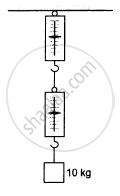
A block of mass 10 kg is suspended from two light spring balances, as shown in the following figure.
A force F1 acts on a particle accelerating it from rest to a velocity v. Force F1 is then replaced by F2 which decelerates the particle to rest.
Give two examples of the following:
Inertia of rest
If a 5 N and a 15 N forces are acting opposite to one another. Find the resultant force and the direction of action of the resultant force.
Newton's first law of motion describes ______.
In the above given problem if the lower thread is pulled with a jerk, what happens?
A smooth sphere of radius R and mass M is placed on the smooth horizontal floor. Another smooth particle of mass m is placed on the sphere and a horizontal force F is applied on the sphere as shown. If the particle does not slip on the sphere then the value of force F is ______.

When does an object accelerate?
