Advertisements
Advertisements
Question
What causes motion in a body?
Advertisements
Solution
APPEARS IN
RELATED QUESTIONS
A body of mass 0.40 kg moving initially with a constant speed of 10 m s–1 to the north is subject to a constant force of 8.0 N directed towards the south for 30 s. Take the instant the force is applied to be t = 0, the position of the body at that time to be x = 0, and predict its position at t = –5 s, 25 s, 100 s.
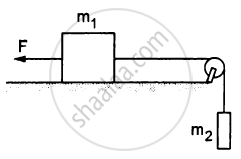
A constant force F = m2g/2 is applied on the block of mass m1 as shown in the following figure. The string and the pulley are light and the surface of the table is smooth. Find the acceleration of m1.
An aeroplane is moving uniformly at a constant height under the action of two forces (i) Upward force (lift) and (ii) Downward force (weight). What is the net force on the aeroplane?
Use Newton's second law of motion to explain the following instance :
An athlete prefers to land on sand instead of hard floor while taking a high jump .
An electron of mass 9 × 10⁻³¹ kg is moving with a linear velocity of 6 × 10⁷ ms−1. Calculate the linear momentum of electron.
Define Newton’s second law of motion.
Which of the following has the largest inertia?
Name the physical quantity which equals the rate of change of linear momentum.
Use Newton's second law to explain the following:
We always prefer to land on sand instead of hard floor while taking a high jump.
What do you mean by the conservation of momentum? Briefly, explain the collision between two bodies and the conservation of momentum.
