Advertisements
Advertisements
Question
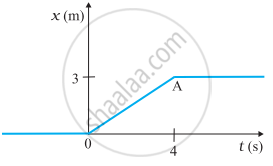
The below figure shows the position-time graph of a particle of mass 4 kg.
- What is the force on the particle for t < 0, t > 4 s, 0 < t < 4 s?
- What is the impulse at t = 0 and t = 4 s? (Consider one-dimensional motion only.)
Advertisements
Solution
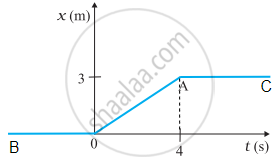
- For t < 0
For t<0, the graph of position versus time is denoted as BO, which indicates that the displacement of the particle is zero, i.e., the particle is stationary at the origin. Consequently, the force exerted on the particle must be zero. - For t > 4 s
For t>4 s, the position-time graph segment AC runs parallel to the time axis, indicating that the particle maintains a position 3 metres from the origin, implying it is stationary. Therefore, the force acting on the particle is zero. - For 0 < t < 4
Between 0 < t < 4 s, the position-time graph labelled OA displays a constant slope, which indicates that the velocity of the particle remains constant during this interval, meaning the particle has zero acceleration. Consequently, the force on the particle must be zero.
- For t < 0
- At t = 0
Impulse = Change in momentum
= mv – mu
Mass of the particle, m = 4 kg
Initial velocity of the particle, u = 0
Final velocity of the particle, `v = 3/4 "m/s"`
∴Impulse = `4(3/4 - 0) = 3 kg "m/s"`
At t = 4 s
Initial velocity of the particle, `u = 3/4 "m/s"`
Final velocity of the particle, v = 0
∴ Impulse = `4(0-3/4)` = -3 kg m/s
APPEARS IN
RELATED QUESTIONS
An aircraft executes a horizontal loop at a speed of 720 km/h with its wings banked at 15°. What is the radius of the loop?
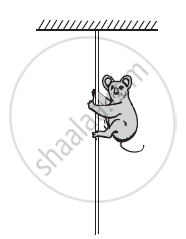
A monkey of mass 40 kg climbs on a rope in given Figure which can stand a maximum tension of 600 N. In which of the following cases will the rope break: the monkey
(a) climbs up with an acceleration of 6 m s–2
(b) climbs down with an acceleration of 4 m s–2
(c) climbs up with a uniform speed of 5 m s–1
(d) falls down the rope nearly freely under gravity?
(Ignore the mass of the rope).
You are travelling in a car. The driver suddenly applies the brakes and you are pushed forward. Why does this happen?
A free 238U nucleus kept in a train emits an alpha particle. When the train is stationary, a nucleus decays and a passenger measures that the separation between the alpha particle and the recoiling nucleus becomes x at time t after the decay. If the decay takes place while the train is moving at a uniform velocity v, the distance between the alpha particle and the recoiling nucleus at a time t after the decay, as measured by the passenger, is
The figure shows the displacement of a particle going along the X-axis as a function of time. The force acting on the particle is zero in the region
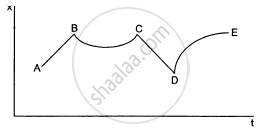
(a) AB
(b) BC
(c) CD
(d) DE
A person is standing on a weighing machine placed on the floor of an elevator. The elevator starts going up with some acceleration, moves with uniform velocity for a while and finally decelerates to stop. The maximum and the minimum weights recorded are 72 kg and 60 kg, respectively. Assuming that the magnitudes of acceleration and deceleration are the same, find (a) the true weight of the person and (b) the magnitude of the acceleration. Take g = 9.9 m/s2.
Suppose the ceiling in the previous problem is that of an elevator which is going up with an acceleration of 2.0 m/s2. Find the elongation.
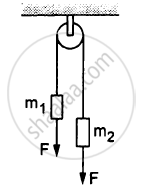
In the following figure, m1 = 5 kg, m2 = 2 kg and F = 1 N. Find the acceleration of either block. Describe the motion of m1 if the string breaks but F continues to act.
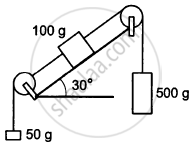
Find the acceleration of the 500 g block in the following figure.
A monkey of mass 15 kg is climbing a rope fixed to a ceiling. If it wishes to go up with an acceleration of 1 m/s2, how much force should it apply on the rope? If the rope is 5 m long and the monkey starts from rest, how much time will it take to reach the ceiling?
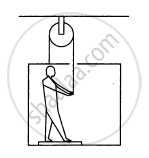
In the following figure shows a man of mass 60 kg standing on a light weighing machine kept in a box of mass 30 kg. The box is hanging from a pulley fixed to the ceiling by a light rope, the other end of which is held by the man himself. If the man manages to keep the box at rest, what is the weight recorded on the machine? What force should he exert on the rope to record his correct weight on the machine?
A force acts for 10 s on a stationary body of mass 100 kg, after which the force ceases to act. The body moves through a distance of 100 m in the next 5 s. Calculate: The velocity acquired by the body.
A pebble is dropped freely in a well from its top. It takes 20 s for the pebble to reach the water surface in the well. Taking g = 10 m s-2 and speed of sound = 330 m s-1. Find : The depth of water surface
A body of mass 200 g is moving with a velocity of 5 ms−1. If the velocity of the body changes to 17 ms−1, calculate the change in linear momentum of the body.
ame the law of motion which gives the definition of force.
What causes motion in a body?
Use Newton's second law to explain the following:
While catching a fast moving ball, we always pull our hands backwards.
In the previous problem (5.3), the magnitude of the momentum transferred during the hit is ______.
How does moving your hand backward while catching a cricket ball reduce pain?
