Advertisements
Advertisements
Question
ame the law of motion which gives the definition of force.
Advertisements
Solution
2nd law of motion gives the definition of force.
APPEARS IN
RELATED QUESTIONS
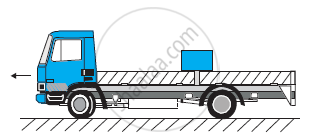
The rear side of a truck is open and a box of 40 kg mass is placed 5 m away from the open end as shown in Figure. The coefficient of friction between the box and the surface below it is 0.15. On a straight road, the truck starts from rest and accelerates with 2 m s–2. At what distance from the starting point does the box fall off the truck? (Ignore the size of the box).
A car accelerates on a horizontal road due to the force exerted by.
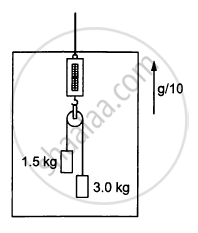
Find the reading of the spring balance shown in the following figure. The elevator is going up with an acceleration g/10, the pulley and the string are light and the pulley is smooth.
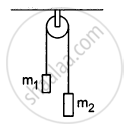
In a simple Atwood machine, two unequal masses m1 and m2 are connected by a string going over a clamped light smooth pulley. In a typical arrangement (In the following figure), m1 = 300 g and m2 = 600 g. The system is released from rest. (a) Find the distance travelled by the first block in the first two seconds; (b) find the tension in the string; (c) find the force exerted by the clamp on the pulley.
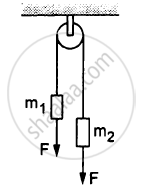
In the following figure, m1 = 5 kg, m2 = 2 kg and F = 1 N. Find the acceleration of either block. Describe the motion of m1 if the string breaks but F continues to act.
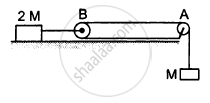
Consider the situation shown in the following figure. Both the pulleys and the string are light and all the surfaces are frictionless.
- Find the acceleration of the mass M.
- Find the tension in the string.
- Calculate the force exerted by the clamp on the pulley A in the figure.
A body of mass m moving with a velocity v is acted upon by a force. Write an expression for change in momentum in each of the following cases: (i) When v << c, (ii) When v → c and (iii) When v << c but m does not remain constant. Here, c is the speed of light.
How can Newton's first law of motion be obtained from the second law of motion?
In the previous problem (5.3), the magnitude of the momentum transferred during the hit is ______.
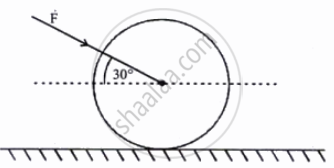
As shown in figure, a 70 kg garden roller is pushed with a force of F = 200 N at an angle of 30° with horizontal. The normal reaction on the roller is: (Given: g = 10 ms−2)