Advertisements
Advertisements
Question
Multiple Choice Question. Select the correct option.
A force acts on a body of mass 3 kg such that its velocity changes from 4 ms−1 to 10 ms−1. The change in momentum of the body is
Options
42 kgms−1
2 kgms−1
18 kgms−1
14 kgms−1
Advertisements
Solution
18 kgms−1
Explanation:
Mass = m = 3 kg
Velocity v1 = 4 ms−1
Velocity = v2 = 10 ms−1
Change in momentum of body
= mv2 – mv1 = m (v2 – v1) = 3 (10 – 4)
= 3 × 6 =18 kgms−1
APPEARS IN
RELATED QUESTIONS
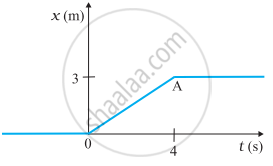
The below figure shows the position-time graph of a particle of mass 4 kg.
- What is the force on the particle for t < 0, t > 4 s, 0 < t < 4 s?
- What is the impulse at t = 0 and t = 4 s? (Consider one-dimensional motion only.)
A block of mass 0.2 kg is suspended from the ceiling by a light string. A second block of mass 0.3 kg is suspended from the first block by another string. Find the tensions in the two strings. Take g = 10 m/s2.
Write the mathematical form of Newton's second law of motion. State the conditions if any.
The correct form of Newton's second law is :
The unit of linear momentum is :
Calculate the magnitude of force which when applied on a body of mass 0.5 kg produces an acceleration of 5 m s-2.
Calculate the velocity of a body of mass 0.5 kg, when it has a linear momentum of 5 Ns.
State Newton's second law of motion. Is Newton's first law of motion contained in Newton's second law of motion?
A stone is dropped from a cliff 98 m high.
What will be its speed when it strikes the ground?
A metre scale is moving with uniform velocity. This implies ______.
