Advertisements
Advertisements
प्रश्न
Multiple Choice Question. Select the correct option.
A force acts on a body of mass 3 kg such that its velocity changes from 4 ms−1 to 10 ms−1. The change in momentum of the body is
पर्याय
42 kgms−1
2 kgms−1
18 kgms−1
14 kgms−1
Advertisements
उत्तर
18 kgms−1
Explanation:
Mass = m = 3 kg
Velocity v1 = 4 ms−1
Velocity = v2 = 10 ms−1
Change in momentum of body
= mv2 – mv1 = m (v2 – v1) = 3 (10 – 4)
= 3 × 6 =18 kgms−1
APPEARS IN
संबंधित प्रश्न
A rocket with a lift-off mass 20,000 kg is blasted upwards with an initial acceleration of 5.0 m s–2. Calculate the initial thrust (force) of the blast.
An aircraft executes a horizontal loop at a speed of 720 km/h with its wings banked at 15°. What is the radius of the loop?
A person drops a coin. Describe the path of the coin as seen by the person if he is in
- a car moving at constant velocity and
- in a free falling elevator.
A free 238U nucleus kept in a train emits an alpha particle. When the train is stationary, a nucleus decays and a passenger measures that the separation between the alpha particle and the recoiling nucleus becomes x at time t after the decay. If the decay takes place while the train is moving at a uniform velocity v, the distance between the alpha particle and the recoiling nucleus at a time t after the decay, as measured by the passenger, is
Suppose the ceiling in the previous problem is that of an elevator which is going up with an acceleration of 2.0 m/s2. Find the elongation.
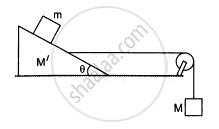
Find the mass M of the hanging block in the following figure that will prevent the smaller block from slipping over the triangular block. All the surfaces are frictionless and the strings and the pulleys are light.
State Newton's second law of motion. Under what condition does it take the form F = ma?
The correct form of Newton's second law is :
State Newton's second law of motion. Is Newton's first law of motion contained in Newton's second law of motion?
According to Newton's Second Law of Motion, what quantity is directly proportional to the applied force?
