Advertisements
Advertisements
प्रश्न
Multiple Choice Question. Select the correct option.
A force acts on a body of mass 3 kg such that its velocity changes from 4 ms−1 to 10 ms−1. The change in momentum of the body is
विकल्प
42 kgms−1
2 kgms−1
18 kgms−1
14 kgms−1
Advertisements
उत्तर
18 kgms−1
Explanation:
Mass = m = 3 kg
Velocity v1 = 4 ms−1
Velocity = v2 = 10 ms−1
Change in momentum of body
= mv2 – mv1 = m (v2 – v1) = 3 (10 – 4)
= 3 × 6 =18 kgms−1
APPEARS IN
संबंधित प्रश्न
You are travelling in a car. The driver suddenly applies the brakes and you are pushed forward. Why does this happen?
A spy jumps from an airplane with his parachute. The spy accelerates downward for some time when the parachute opens. The acceleration is suddenly checked and the spy slowly falls to the ground. Explain the action of the parachute in checking the acceleration.
Two blocks A and B of mass mA and mB , respectively, are kept in contact on a frictionless table. The experimenter pushes block A from behind, so that the blocks accelerate. If block A exerts force F on block B, what is the force exerted by the experimenter on block A?
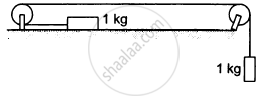
Calculate the tension in the string shown in the following figure. The pulley and the string are light and all the surfaces are frictionless. Take g = 10 m/s2.
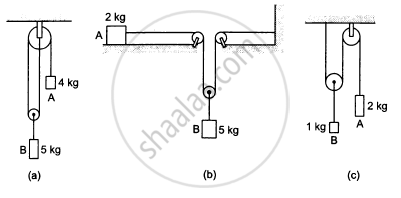
Find the acceleration of the blocks A and B in the three situations shown in the following figure.
A body of mass 5 kg is moving with velocity 2 m s-1. Calculate its linear momentum.
State two factors which determine the momentum of a body.
What causes motion in a body?
Why is it advantageous to turn before taking a long jump?
What do you mean by linear momentum of a body? A force causes an acceleration of 10 ms-2 in a body of mass 1 kg. What acceleration will be caused by the same force in a body of mass 4 kg?
