Advertisements
Advertisements
प्रश्न
How can Newton's first law of motion be obtained from the second law of motion?
Advertisements
उत्तर
From Newton's second law of motion, F = ma.
If F = 0, then a = 0.
This means that if no force is applied on the body, its acceleration will be zero. If the body is at rest, then it will remain in the state of rest and if it is moving, then it will remain moving in the same direction with the same speed. Thus, a body not acted upon by an external force, does not change its state of rest or motion. This is the statement of Newton's first law of motion.
APPEARS IN
संबंधित प्रश्न
A car accelerates on a horizontal road due to the force exerted by.
A man has fallen into a ditch of width d and two of his friends are slowly pulling him out using a light rope and two fixed pulleys as shown in the following figure. Show that the force (assumed equal for both the friends) exerted by each friend on the road increases as the man moves up. Find the force when the man is at a depth h.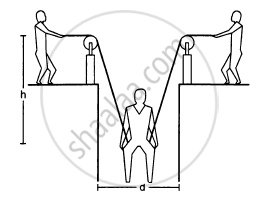
Suppose the ceiling in the previous problem is that of an elevator which is going up with an acceleration of 2.0 m/s2. Find the elongation.
Show that the rate of change of momentum = mass × acceleration. Under what condition does this relation hold?
A bullet of mass 50 g moving with an initial velocity 100 m s-1 strikes a wooden block and comes to rest after penetrating a distance 2 cm in it. Calculate: (i) Initial momentum of the bullet, (ii) Final momentum of the bullet, (iii) Retardation caused by the wooden block and (iv) Resistive force exerted by the wooden block.
A ball is thrown vertically upwards. It returns 6 s later. Calculate the greatest height reached by the ball. (Take g = 10 m s−2)
A body of mass 200 g is moving with a velocity of 5 ms−1. If the velocity of the body changes to 17 ms−1, calculate the change in linear momentum of the body.
State Newton's second law of motion. Is Newton's first law of motion contained in Newton's second law of motion?
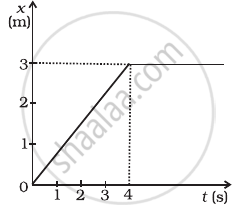
The position time graph of a body of mass 2 kg is as given in figure. What is the impulse on the body at t = 0 s and t = 4 s.
What happens when a car brakes to come to a stop?
