Advertisements
Advertisements
प्रश्न
State Newton's second law of motion. Under what condition does it take the form F = ma?
Advertisements
उत्तर
According to Newton's second law of motion, the rate of change of momentum is directly proportional to the force applied on it, and the change of momentum takes place in the direction in which the force is applied.
The relation F = ma holds for the following conditions:
(i) When the velocity of the body is much smaller than the velocity of light.
(ii) When the mass remains constant.
APPEARS IN
संबंधित प्रश्न
A constant retarding force of 50 N is applied to a body of mass 20 kg moving initially with a speed of 15 ms–1. How long does the body take to stop?
An aircraft executes a horizontal loop at a speed of 720 km/h with its wings banked at 15°. What is the radius of the loop?
The rear side of a truck is open and a box of 40 kg mass is placed 5 m away from the open end as shown in Figure. The coefficient of friction between the box and the surface below it is 0.15. On a straight road, the truck starts from rest and accelerates with 2 m s–2. At what distance from the starting point does the box fall off the truck? (Ignore the size of the box).

An empty plastic box of mass m is found to accelerate up at the rate of g/6 when placed deep inside water. How much sand should be put inside the box so that it may accelerate down at the rate of g/6?
What do you understand by the term momentum?
A ball is thrown upward and reaches a maximum height of 19.6 m. Find its initial speed?
What do you mean by the conservation of momentum? Briefly, explain the collision between two bodies and the conservation of momentum.
A metre scale is moving with uniform velocity. This implies ______.
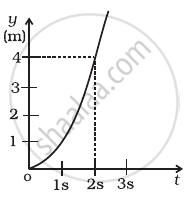
Figure shows (x, t), (y, t ) diagram of a particle moving in 2-dimensions.
|
|
 (b) |
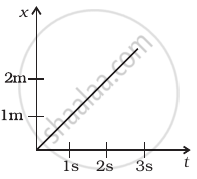
If the particle has a mass of 500 g, find the force (direction and magnitude) acting on the particle.
What happens when a car brakes to come to a stop?
