Advertisements
Advertisements
प्रश्न
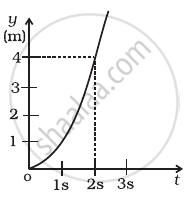
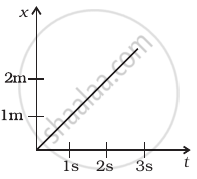
Figure shows (x, t), (y, t ) diagram of a particle moving in 2-dimensions.
|
|
 (b) |
If the particle has a mass of 500 g, find the force (direction and magnitude) acting on the particle.
Advertisements
उत्तर
Clearly, from the diagram (a), the variation can be related as x = t
⇒ `(dx)/(dt)` = 1 m/s
ax = 0
From diagram (b) y = t2
⇒ `(dy)/(dt)` = 2t or ay = `(d^2y)/(dt^2)` = 2 m/s2
Hence, Iy = may = 500 × 10–3 × 2 = 1 N .....(∵ m = 500 g)
Fx = max = 0
Hence, net force, F = `sqrt(F_x^2 + F_y^2)` = Fy = 1 N .....(along y-axis)
APPEARS IN
संबंधित प्रश्न
A helicopter of mass 1000 kg rises with a vertical acceleration of 15 m s–2. The crew and the passengers weigh 300 kg. Give the magnitude and direction of the
(a) force on the floor by the crew and passengers,
(b) action of the rotor of the helicopter on the surrounding air,
(c) force on the helicopter due to the surrounding air.
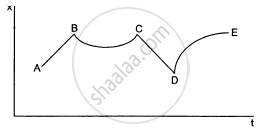
The figure shows the displacement of a particle going along the X-axis as a function of time. The force acting on the particle is zero in the region
(a) AB
(b) BC
(c) CD
(d) DE
Consider the Atwood machine of the previous problem. The larger mass is stopped for a moment, 2.0 s after the system is set into motion. Find the time that elapses before the string is tight again.
A monkey is climbing on a rope that goes over a smooth light pulley and supports a block of equal mass at the other end in the following figure. Show that whatever force the monkey exerts on the rope, the monkey and the block move in the same direction with equal acceleration. If initially both were at rest, their separation will not change as time passes.
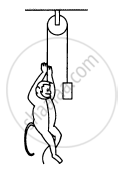
A block is kept on the floor of an elevator at rest. The elevator starts descending with an acceleration of 12 m/s2. Find the displacement of the block during the first 0.2 s after the start. Take g = 10 m/s2.
An aeroplane is moving uniformly at a constant height under the action of two forces (i) Upward force (lift) and (ii) Downward force (weight). What is the net force on the aeroplane?
A tennis ball and a cricket ball , both are stationary. To start motion in them .
State the Newton's second law of motion. What information do you get from it?
The correct form of Newton's second law is :
The linear momentum of a ball of mass 50 g is 0.5 kg m s-1. Find its velocity.
A car is moving with a uniform velocity 30 ms-1. It is stopped in 2 s by applying a force of 1500 N through its brakes. Calculate the following values : The change in momentum of car.
How long will a stone take to fall to the ground from the top of a building 80 m high
A stone is dropped freely from the top of a tower and it reaches the ground in 4 s. Taking g = 10m s-2, calculate the height of the tower.
A body of mass 200 g is moving with a velocity of 5 ms−1. If the velocity of the body changes to 17 ms−1, calculate the change in linear momentum of the body.
Multiple Choice Question. Select the correct option.
Which of the following are vector quantities?
A stone is dropped from a tower 98 m high. With what speed should a second stone be thrown 1 s later so that both hit the ground at the same time?
Why does a child feel more pain when she falls down on a hard cement floor, than when she falls on the soft muddy ground in the garden?
What happens when a car brakes to come to a stop?
As shown in figure, a 70 kg garden roller is pushed with a force of F = 200 N at an angle of 30° with horizontal. The normal reaction on the roller is: (Given: g = 10 ms−2)