Advertisements
Advertisements
प्रश्न
A block is kept on the floor of an elevator at rest. The elevator starts descending with an acceleration of 12 m/s2. Find the displacement of the block during the first 0.2 s after the start. Take g = 10 m/s2.
Advertisements
उत्तर
The free-body diagram of the system is shown below: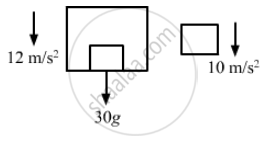
The two bodies are separated because the elevator is moving downward with an acceleration of 12 m/s2 (>g) and the body moves with acceleration, g = 10 m/s2 [Freely falling body]
Now, for the block:
g = 10 m/s2, u = 0, t = 0.2 s
So, the distance travelled by the block is given by
\[s = ut + \frac{1}{2}a t^2 \]
\[ = 0 + \frac{1}{2}10 \times \left( 0 . 2 \right)^2 = 5 \times 0 . 04\]
= 0 . 2 m = 20 cm
The displacement of the body is 20 cm during the first 0.2 s.
APPEARS IN
संबंधित प्रश्न
A stone of mass m tied to the end of a string revolves in a vertical circle of radius R. The net forces at the lowest and highest points of the circle directed vertically downwards are: [Choose the correct alternative]
| Lowest Point | Highest Point | |
| a) | mg – T1 | mg + T2 |
| b) | mg + T1 | mg – T2 |
| c) | `mg + T1 –(m_v_1^2)/R` | mg – T2 + (`mv_1^2`)/R |
| d) | `mg – T1 – (mv)/R` | mg + T2 + (mv_1^2)/R |
T1 and v1 denote the tension and speed at the lowest point. T2 and v2 denote corresponding values at the highest point.
An aircraft executes a horizontal loop at a speed of 720 km/h with its wings banked at 15°. What is the radius of the loop?
You are travelling in a car. The driver suddenly applies the brakes and you are pushed forward. Why does this happen?
When a horse pulls a cart, the force that helps the horse to move forward is the force exerted by
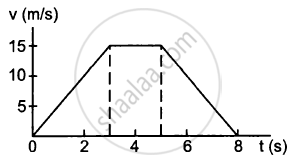
A particle of mass 50 g moves in a straight line. The variation of speed with time is shown in the following figure. Find the force acting on the particle at t = 2, 4 and 6 seconds.
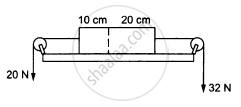
In the following figure shows a uniform rod of length 30 cm and mass 3.0 kg. The strings shown in the figure are pulled by constant forces of 20 N and 32 N. Find the force exerted by the 20 cm part of the rod on the 10 cm part. All the surfaces are smooth and the strings and the pulleys are light.
In the previous problem, suppose m2 = 2.0 kg and m3 = 3.0 kg. What should be the mass m, so that it remains at rest?
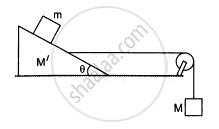
Find the mass M of the hanging block in the following figure that will prevent the smaller block from slipping over the triangular block. All the surfaces are frictionless and the strings and the pulleys are light.
A monkey of mass 15 kg is climbing a rope fixed to a ceiling. If it wishes to go up with an acceleration of 1 m/s2, how much force should it apply on the rope? If the rope is 5 m long and the monkey starts from rest, how much time will it take to reach the ceiling?
Define linear momentum and state its S.I. unit.
Use Newton's second law of motion to explain the following instance :
An athlete prefers to land on sand instead of hard floor while taking a high jump .
A force of 10 N acts on a body of mass 2 kg for 3 s, initially at rest. Calculate : Change in momentum of the body.
ame the law of motion which gives the definition of force.
What do you mean by linear momentum of a body?
What do you mean by linear momentum of a body? A force causes an acceleration of 10 ms-2 in a body of mass 1 kg. What acceleration will be caused by the same force in a body of mass 4 kg?
A stone is dropped from a cliff 98 m high.
How long will it take to fall to the foot of the cliff?
What do you mean by the conservation of momentum? Briefly, explain the collision between two bodies and the conservation of momentum.
The INCORRECT statement about Newton's second law of motion is
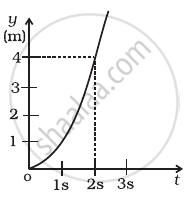
Figure shows (x, t), (y, t ) diagram of a particle moving in 2-dimensions.
|
|
 (b) |
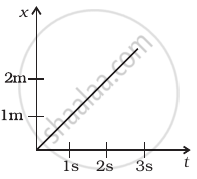
If the particle has a mass of 500 g, find the force (direction and magnitude) acting on the particle.
